
Altaf Hussain, the notorious MQM leader who swapped Pakistan for London
Altaf Hussain lives in London but leads Pakistan's powerful,
controversial MQM party, which has millions of supporters. He has also
been acccused of inciting murder and violence in his home country.
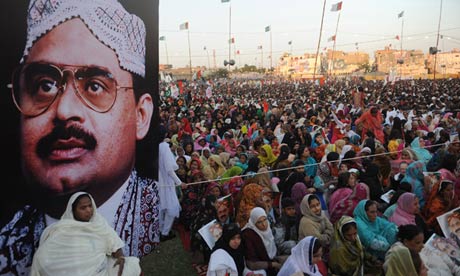
MQM supporters gather at a rally in Karachi, Pakistan in January 2011. Photograph: Rizwan Tabassum/AFP/Getty Images
Pakistan's most vibrant, vivacious and popular 24-hour news channel,Geo TV,
generally has little difficulty recruiting staff. Its headquarters are
in Karachi, Pakistan's so called "city of dreams" – a massive, sprawling
conurbation with 20 million residents seeking a better life. And yet
there was one vacancy recently that Geo TV could not fill. The channel
wanted a lookalike for its popular satirical show, in which actors play
the parts of the country's leading politicians. It was a job offering
instant stardom and good money. And not a single person in Karachi was
willing to do it.
The man Geo TV sought to satirise was Altaf Hussain,
the leader of the Muttahida Qaumi Movement (MQM). And the reason no one
applied was the fear that if Altaf Hussain were unamused by the
performance, the actor playing him would be murdered.
Anxiety about the MQM is not restricted to Pakistan. One member of the
British House of Lords who has been openly critical of the MQM recently
said: "If I went to Karachi now I would be killed." Another peer has
similar worries: "This is one issue I don't ask questions on. I have my
child to worry about."
The man who has everyone looking over his or her shoulder does not even
live in Karachi. For more than 20 years, Altaf Hussain has operated from
the north London suburb of Edgware, beyond the reach of Pakistani
prosecutors. He is almost completely unknown in the UK: his
four-million-plus devoted supporters live thousands of miles away.
It's difficult to know how many murder cases have been registered
against Altaf Hussain, but perhaps the most authoritative number was
released in 2009 when the then Pakistani president General Pervez
Musharraf implemented his National Reconciliation Order, granting most
of the country's senior politicians an amnesty. One of the biggest
beneficiaries was Hussain, against 72 cases were dropped, including 31
allegations of murder. The MQM rejects all the murder charges lodged
against Hussain.
When Pakistan was created in 1947 it had a population of 70 million. As
well as the Bengalis in East Pakistan (who split away to form Bangladesh in 1971)
there were four main indigenous groups: the Sindhis, the Baloch, the
Pashtuns and the Punjabis. Partition brought a new element: Muslims who
had fled Hindu-majority India. They were called the Mohajirs and most
settled in Karachi, which was then the capital of Pakistan. This is the
group represented by the Mohajir Qaumi Movement or, as it's now named,
the Muttahida (United) Qaumi Movement or MQM.
At first the Mohajirs fared well. As many had spearheaded the campaign
to create the country, they slipped naturally into leadership positions.
But their disproportionate influence could never last. By the 70s a
political backlash, especially from Punjabis and Sindhis, was in full
swing and many Mohajirs found themselves unable to secure jobs or even
places in schools and universities. For a group that thought it had the
right to govern, it came as a heavy blow. And the first man to exploit
the Mohajirs' sense of grievance was Hussain.
In 1988 MQM candidates broke through, and suddenly the party was the
third largest in the National Assembly and has dominated Karachi
politics ever since. Hussain has periodically flirted with demands for
some kind of territorial settlement: "When everyone else had a
province," he said in March 1984, "we said the Mohajirs should have one
too." But for the most part he has accepted that such a demand is
plainly unacceptable to the rest of Pakistan and has restricted himself
to demands for greater Mohajir rights within the existing national
framework.
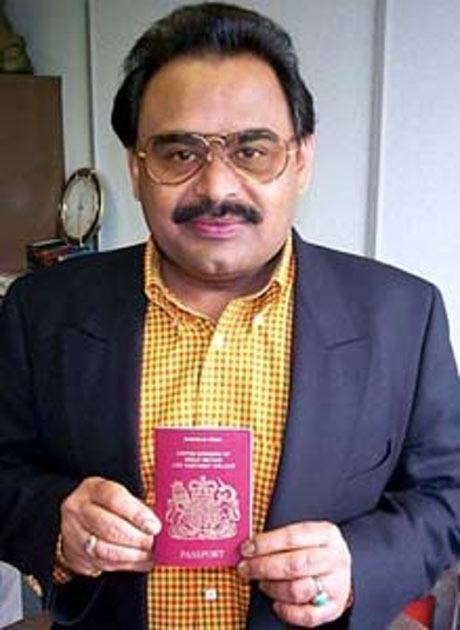 Altaf Hussain with his British passport, granted in 2002.
The MQM's most vocal critic today is cricketer-turned-playboy-turned-Islamist-politician Imran Khan.
In 2007, portraying himself as the man who dared to confront even the
most entrenched political interests, Khan paid a visit to the
Metropolitan police in London to hand over, he claimed, evidence of
Hussain's wrongdoing. Apparently unimpressed with the quality of that
evidence, the police did not bring any charges and Khan let the issue
drop. But in May this year when one of his best-known party activists in
Karachi, Zahra Shahid Hussain, was shot down outside her home, Khan openly accused the MQM of her murder.
Thousands of his social media-savvy supporters were encouraged to
complain to the British police. More than 12,000 did so and the police
responded by, for the first time, formally investigating Altaf Hussain's
London activities.
There are a number of strands to the Met's inquiries. First there is the
issue of whether the MQM leader is using his London base to incite
violence in Pakistan. In assessing that, the police have a huge amount
of material to sift through, much of it online. At his birthday party in
2009, for example, he regaled his guests with a remark aimed at
Pakistan's rich landowners and businessmen: "You've made big allegations
against the MQM. If you make those allegations to my face one more time
you'll be taking down your measurements and we'll prepare your body
bags."
Because he is in London, Hussain addresses rallies in Karachi over the
telephone. Crowds gather to listen to his voice through loudspeakers. In
one such speech he had this message for TV anchors: "If you don't stop
the lies and false allegations that damage our party's reputation, then
don't blame me, Altaf Hussain, or the MQM if you get killed by any of my
millions of supporters."
Most of his threats have been aimed at people in Pakistan but at least
one was directed at the UK journalist Azhar Javaid who asked a question
once too often. At a press conference in September 2011 Hussain warned
Javaid that his "body bag was ready".
Adressing those whom he accused of denying the Mohajirs their rights, in
December 2012, Hussain ranted: "If your father won't give us freedom
just listen to this sentence carefully: then we will tear open your
father's abdomen. To get our freedom we will not only tear it out of
your father's abdomen but yours as well."
Partly because of the difficulty of establishing unchallengeable
translations of Hussain's words, it might be months before the police
decide whether to recommend a prosecution. In the meantime there is talk
of a private prosecution. Long-time MQM critic George Galloway MP
recently set up a fund to pay the legal fees of such an initiative.
On two occasions British judges have found that the MQM is a violent
organisation. In 2010 a Karachi-based police officer sought asylum in
the UK claiming the MQM was threatening to kill him in revenge for his
having registered a case against one of its members. The judge, Lord
Bannatyne, granted asylum and in his judgment accepted that: "the MQM
has killed over 200 police officers who stood up to them in Karachi".
The figure is often cited by the Karachi police themselves, and refers
to those officers who were closely involved in Benazir Bhutto's anti-MQM
crackdown, Operation Clean-up. It came in 1995, during Bhutto's second
government. Unable to rely on the slow, intimidated and corrupt courts,
which were always nervous to convict MQM defendants, the security forces
resorted to hundreds if not thousands of extrajudicial killings of MQM
activists. Many of the police officers responsible have subsequently
been murdered. MQM, however, refutes any allegations of inciting
violence from London.
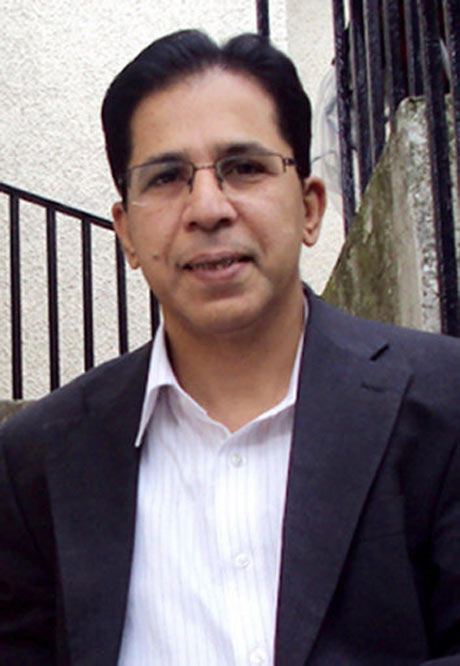 Imran Farooq was stabbed to death outside his flat in north London. Photograph: Metropolitan Police/PA
When asked about these allegations, MQM issued the following statement
to the Guardian: "We'd also like to point out here that it is the MQM
that has been the worst victim of violence in recent history of the
country. The Taliban and other jihadi elements have killed scores of MQM
members … "
As well as the incitement investigation, the British police are
currently running another MQM-related inquiry. It concerns the September
2010 murder of a senior MQM member, Imran Farooq, who was stabbed to
death outside his flat in Green Lane, Edgware. For the UK authorities,
his murder crossed a red line. London is open to outsiders – but they
have to leave their violent politics back home.
The Counter Terrorism Command have launched a massive and sustained
investigation into Farooq's death. In December last year they raided the
MQM's Edgware offices where they found substantial thousands of
documents. Since most of the material is in Urdu and some, from MQM
lawyers, is subject to client privilege, assessing it is extremely
time-consuming. But with 12 officers working on the case full-time and a
whole range of specialists available to carry out specific tasks when
needed, the police are still showing real determination to trace
Farooq's killer.
In its statement to the Guardian, the MQM said: "MQM understands that as
part of that ongoing investigation, the Metropolitan police have
interviewed several hundred people. MQM has assisted the ongoing police
investigation whenever it has been requested to do so. A number of MQM
party members have also voluntarily offered to be witnesses to assist
the ongoing police investigation. Mr Altaf Hussain, MQM's party leader,
has not been arrested nor charged with any criminal offence. The police
are treating Mr Hussain as one of a large number of potential witnesses
in their investigation and not as a suspect."
Right from the start the police raids in the investigation have produced
rich material. Shortly after the 2010 murder the police found a
significant number of papers stashed in Farooq's home. Some of the
documents gave credence to the confessions made by a number of suspected
MQM militants in Karachi. Repeatedly, MQM activists there had told the
Pakistani authorities they were trained in India. Asked on numerous
occasions over a period of several weeks about its relationship with the
MQM, Indian government officials have failed to make any statement on
the matter. Recent police raids have turned up £150,000 at the party's
Edgware's offices and £250,000 at Hussain's house in Mill Hill.
The police say they are making significant progress in the Farooq murder
case and have an ever-clearer understanding of what they believe was a
conspiracy to kill him. Their investigation, however, is complicated by
the fact that the MQM has supporters deep within the Pakistani state who
want to protect it, and more cynical actors such as Pakistan's main
intelligence agency, the ISI, which want to control it.
However, the recent elections in Pakistan have
left the MQM politically weaker and there is a distinct possibility
that the government of Nawaz Sharif will be less protective of the MQM
than the last administration.
Aware that Farooq's killer or killers may be thousands of miles away
and, the British Police believe, back in Pakistan, the UK investigation
has focused on who might have ordered the murder. Having promised full
co-operation with the British authorities Hussain has also complained
that he is the subject of a witch-hunt and a conspiracy.
Recent British police actions have included the arrest (he is now bailed
until September) of Altaf Hussain's nephew, Ishtiaq Hussain. The police
won't divulge why he was arrested. Intriguingly, Altaf Hussain also let
slip that he himself and MQM were being investigated for money
laundering. This is now one of the most active elements of the British
police's work. The question is: where does all the money seized in the
raids and that used to buy the MQM's extensive UK property portfolio
come from? In the statement to the Guardian, the MQM deny the laundering
allegations.
"It is reiterated here that the party, its leader Mr Altaf Hussain or
any other member of the Party has never dealt with any money that is the
proceeds of crime.
MQM's legal team has already submitted effective answers to questions
concerning the cash seized from the party's office, whereas legal
responses would be submitted shortly concerning the cash seized from
Mr Altaf Hussain's residence."
With a condescension that is increasingly grating to the Pakistani
public, Washington and London produce a regular flow of statements
expressing concern about various Pakistani human rights abuses. But the
whole issue of human rights monitoring is suffused with double
standards. The abuses listed by the US and the UK are in fact little
more than diplomatic ammunition held in reserve and deployed should the
need arise.
The UK itself has questions to answer. It has resisted repeated
Pakistani requests to hand over Hussain so that he can stand trial for
murder in Pakistan. Hussain arrived in London in February 1992 and just
three years later, Benazir Bhutto – then prime minister – was asking for
London's help. "I think the British government has a moral
responsibility to restrain Mr Altaf Hussain and say you cannot use our
soil for violence," she said. Eighteen years later, Imran Khan's appeal
was strikingly similar: "I blame the British government. Would they
allow someone to sit in Pakistan and threaten people in the UK? They
know about his track record."
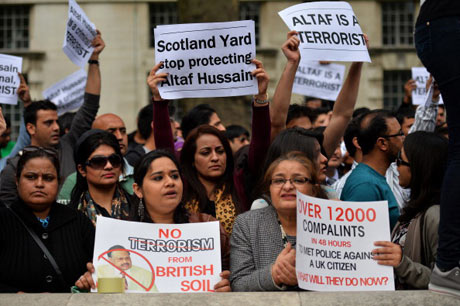 A protest against Altaf Hussain, outside Downing street in May this years Photograph: AFP/Getty Images
If Hussain were a suspected London-based jihadi, many Pakistanis believe, he would have been arrested years ago.
Pakistanis point to other instances where they believe the UK has
favoured Hussain. In 2002 he was issued with a UK passport. Off the
record, British officials admit that the process by which he obtained
nationality was flawed – a decision in January 1999 to grant him
indefinite leave to remain in the UK was made as a result of a "clerical
error". Despite repeated questions, the Home Office has refused to
disclose what that error was.
Most Pakistanis dismiss the idea of a clerical error as risible. They
point to a letter No 10 received from Hussain as evidence of how the UK
and the MQM have tried to conceal the true nature of their relationship.
Written just two weeks after 9/11, in it Hussain says that if the UK
wanted hundreds of thousands of people on the streets of Karachi
denouncing terrorism he could lay that on with just five days' notice.
He claimed he could also organise human intelligence on the Taliban and
could set up a network of fake aid workers in Afghanistan to back up
Western intelligence gathering efforts there.
After a copy of the letter appeared on the internet, the MQM denied its
authenticity. Disclosures under the Freedom of Information Act have
established that the letter is in fact authentic. Faced with that
information, the Foreign Office admitted it had received the letter.
As Hussain suggests in the letter, British interest in the MQM is
largely driven by the perception that the party offers a defence against
jihadis. But there is more to it than that. The MQM is British turf:
Karachi is one of the few places left on earth in which the Americans
let Britain take the lead. The US consulate in Karachi no longer runs
active intelligence gathering operations in the city. The British still
do. When it comes to claiming a place at the top table of international
security politics – London's relationship with the MQM is a remaining
toehold.
And there's something else. The FCO's most important currency is
influence. Successive Pakistani governments, when they are not demanding
Hussain's extradition, have included his parliamentary bloc in various
coalition governments. From the FCO's point of view, it's a great source
of access. Right on their doorstep, in London, they have a man with
ministers in the Pakistani government.
For its part the UK government insists there is nothing unusual about
its contacts with MQM and that its meetings with MQM officials are: "a
normal part of diplomatic activity around the world". I spoke to a
British official recently about the MQM and asked why the UK government,
so keen to declare its commitment to human rights, seemed so willing to
deal with the party despite officials privately saying that it uses
violence to achieve its goals. She said: "There is one thing I can
assure you of – it's not a conspiracy." Which in a sense is true. It's
not a conspiracy. It's just policy.


No comments:
Post a Comment