Showing posts with label SINDH. Show all posts

April 12, 2013

THE MOST IMPORTANT MAN OF SUB-CONTINENT RAJA DAHIR

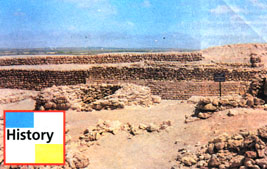
Ruins of Bhanbore, supposed to be the legendary city of 'Debal'
Rajah Dahar of Sindh
"Whoever marries your sister will become the ruler of Sindh," the astrologers told Dahar, the Rajah of Sindh. Dahar was the eldest son of Chach, the founder of the Brahmin Dynasty in Sindh, and he had inherited lower Sindh. His younger brother, Daharsingh was ruling upper Sindh, and both of them were born of Suhandi, the ambitious wife of Chach. Bai, their sister whose horoscope posed a dilemma for Dahar, was born of a Jatt mother.

"The administration of a large kingdom is a delicate matter," said the grand vizier Budhiman to Dahar. "For the sake of their kingdom, kings bring death upon their brothers and relatives or banish them from their country. You should marry your sister, and seat her with you on the throne though you will never consummate the marriage. As she will be called your wedded wife the kingdom will remain with you, according to the astrologers' prediction." When this argument didn't convince Dahar, the grand vizier made a practical demonstration about the so-called collective memory of the people. He laid mud on the back of a sheep, and grew plants on it. When the sheep was paraded through the streets of Aror, it caught everyone's attention. But only for three days! Afterward, the sheep would roam around in the streets and no one would pay heed to it. That much is the human attention span.

Much has been said about Dahar's marriage to his sister, but as far as we can gather from recorded history it was a nominal marriage and never consummated. Yet, it earned Dahar a bad reputation, so that his name became proverbial and synonymous with "big mistake" in the Sindhi language. His younger brother, Daharsingh, who was ruling the northern areas of the empire, rose in rebellion, although death overtook him before a decisive battle could settle the affairs between the brothers. The true casualty of this whole affair goes mostly unnoticed by the historians of all schools. The saddest part of the story was perhaps the fact that a young woman was condemned to a life that she did not deserve.

Apart from his "big mistake," Dahar certainly possessed some remarkable characteristics. He was exceptionally brave and fearless. There is even a story about how, when a ferocious lion once attacked Dahar's hunting retinue, Dahar wrapped his scarf on his left arm and thrust that arm into the lion's mouth while killing the beast with his right arm. Even if we don't believe this story, we have witnesses to his other acts of bravery, and such witnesses are found even among his enemies, the Arab invaders. As described by the ancient historians, Rajah Dahar is the tragedy of a man who set out to take lessons in being a king. His flaw was his willingness to place his faith in the external factors: stars, destiny, enemies and friends. By the time Dahar learnt his lessons, it was too late for him to live like a king. The only option left before him by then was to die like one.

Dahar had the opportunity to rule for a long period over his kingdom - almost forty years (c. 668 - 712 AD). Over that period his major achievement was to secure law and order in his land by routing the bandits and banishing them to the seas. His major weakness was his foreign policy, specially towards the western borders of his empire where the threat of an Arab invasion was increasing everyday since the Arab occupation of Persia in 635 AD.

It seems that Dahar was nostalgically looking back towards the days of the pre-Islamic Persia when the glorious Sassanid Dynasty ruled over that vast empire with great pomp and show. It was difficult for him to accept that the ancient glory of Iran had gone forever, and he could never make up his mind to deal with the Bedouins of the Arab Deserts as successors of the great Persian Emperors.

The Arabs, at the same time, displayed no desire for establishing friendly relations with the other powers of their time. Specially in the case of Sindh, the Arabs had always been speaking in terms of whether it was difficult or easy to annex this state, and never in terms of whether or not the Sindhis have given them a cause for invasion. We must remember that "world peace" is a very modern term and has its origin in the Romantic Movement of the 18th and 19th Century. Even so it wasn't until after the World War I in the 20th Century that the concept of world peace became a reality in the foreign policies of states. The modern Muslim historians, more than anyone else, are guilty of anachronism when they try to perceive of the early Arab colonialism in terms of the 20th Century notions of democracy and world peace.

Dahar, it seems, didn't display any personal aversion to the Muslims or their religion. He welcomed the Arab talent at his court, and was a great admirer of the Arab military genius. Unfortunately, the Arabs who found refuge at Dahar's court were the Allafi adversaries of the Umayyad Caliphate. It is said that one of their relatives, a dignitary of the Allafi tribe, was beheaded in Mekran by a deputy of Hajjaj bin Yousuf as he refused to pay proper honour to that deputy. His skin was taken off and his head sent to Basra. In true Arab spirit some of the tribesmen of the victim took their revenge upon the deputy, who had by that time become the governor of Mekran, and then fled to the court of Dahar.

We cannot be certain how far the famous story about the plunder of eight Arab ships at Debal is true. It has been recorded in most histories that the King of Sarandeep had sent some gifts to the Umayyad Caliph Walid bin Abdul Malik, and the caravan of eight ships also carried the orphaned daughters of deceased Arab merchants. These ships were forced by rough weather to take refuge on the coasts of Sindh, possibly Debal, and there they were looted by some outlandish tribes. The story even relates that one of the women called upon Hajjaj when she was being captured, and this message was conveyed to Hajjaj by a survivor. Hajjaj sent a letter to Dahar asking him to release the women, and we are told by historians that, "in that letter he couched many threats in very strong terms." If that was the case then Dahar must be praised for his patience in replying only, "This is the work of a band of robbers over whom I do not have power."

Mainly two facts make this story doubtful. Firstly, Chachnameh, the primary source of these events, narrates that when Muhammad bin Qasim later conquered Debal he found all the women in the castle prison. Why would those women be kept in the prison? Women captured in this manner were usually treated as slave girls and distributed among the captors for their pleasures, as Mohammad Bin Qasim reportedly did at the time of his capture of Sindh.

Secondly, the Chachnameh states again in the events of a year later that after the Arabs had conquered almost all of Sindh, the Hindu vizier Siyakar brought those Muslim women prisoners to Muhammad bin Qasim. How could they be freed now, if they had been already freed and sent home from Debal? Indeed, it seems that the story had become a folk tale and there were many versions of it. We can't be sure that the version that has come down to us was closest to reality.

In the light of what we know, it is more plausible to believe that some ships were probably looted but that was an act of the robbers whom Dahar had banished from his lands with great difficulty and now didn't want to provoke by challenging their hold over the seas. Dahar's personal involvement in the events, as well as the captives' release from the prisons of Debal and (or) Alore, seems to be a fabrication by the later storytellers for obvious reasons.

The events of Muhammad bin Qasim's invasion of Sindh are well known. What isn't so well known to most students of history is the manner in which Raja Dahar met his death. It is said that when the Arab conqueror had captured most of Sindh, and Dahar's countrymen had changed their sides to join the Arabs, Dahar called his Arab friends, the Allafi rebels. In a way they were the cause of Dahar's misfortune because it was by giving them refuge that Dahar had first annoyed the dreadful Hajjaj bin Yousuf. "O Allafi!" Dahar said to his Arab friend, "It was for such an emergency that we patronized you. You are best acquainted with the ways of the Arab army, and it is advisable that you should go with my forces in advance." The Allafi replied, "O King! We are grateful to you, but we cannot draw our swords against the army of Islam. If we are killed by them we will earn a bad name, and if we kill them we will burn in hell. We agree that in return for the favours you have shown us, we must at least give you some advice on how to fight these invaders even if we do not draw our swords against them. But if we give you advice, then again, this army will never forgive us. Please be kind to us and allow us to depart quietly." In a magnanimous gesture of royal grace, Dahar allowed these dubious characters to leave his camps in safety.

Sometime before the final battle, Dahar's vizier approached him and suggested that Dahar should take refuge with one of the friendly kings of India. "You should say to them, 'I am a wall between you and the Arab army. If I fall, nothing will stop your destruction at their hands.'" If that wasn't acceptable to Dahar, said the vizier, then he should at least send away his family to some safe point in India. Dahar refused to do either. "I cannot send away my family to security while the families of my thakurs and nobles remain here. And I consider it shameful as well that I should go to the door of another prince and await his permission to see him." Vizier Budhiman then asked Dahar what did he intend to do. To this Dahar gave a very dramatic reply, which was recorded faithfully by the early Arab historians despite their hostility to the unfortunate infidel. 
"I am going to meet the Arabs in the open battle", he said, "And fight them as best as I can. If I crush them, my kingdom will then be put on a firm footing. But if I am killed honorably, the event will be recorded in the books of Arabia and India, and will be talked about by great men. It will be heard by other kings in the world, and it will be said that Rajah Dahar of Sindh sacrificed his precious life for the sake of his country, in fighting with the enemy."

After Dahar was killed in the Battle of Aror on the banks of the River Indus, his head was cut off from his body and sent to Hajjaj bin Yousuf. His queens burnt themselves to death in the tradition set by the Rajput heroines. These included Bai, the unfortunate sister of Dahar. Other ladies of the royal household, who remained alive, were captured by the Arab conquerors along with other women of Sindh, and sold into slavery. Thus ended the dynasty that had sprung out of the ambitions of Queen Suhandi and Chach the Brahmin.

April 5, 2013

Comrade Sobho Gianchandani is one of the oldest living communists in the subcontinent.


At age 88, Comrade Sobho Gianchandani is one of the oldest living communists in the subcontinent. He has seen it all, done it all - and still believes that communism will return to the world in a big way. In this wide-ranging interview conducted at his Larkana home, where he lives with his family, the "son of the soil," as he refers to himself, takes Newsline on a reflective journey into the past. From his days at Shantiniketan to his involvement in the politics of pre-Partition and post-Partition Pakistan, it's been an action-packed life.

Q: What made you decide to study at Shantiniketan?

A: In 1939, when I passed my intermediate, one of my classmates, Lekhu Tulsani, asked me what I had decided to do. I told him I wanted to devote my time to Rabindranath Tagore at Shantiniketan instead of pursuing my initial aim of becoming a lawyer. Shantiniketan was a reputable institution with a vibrant environment, well known for its education in the various arts, and it also housed several international communities - Chinese, Indonesians, Americans etc. I sent a telegram to Tagore saying, "I am of good character, a good student and want to study at Shantiniketan. But I am not prepared to clear a technical pre-entry test at your institution." One day, I received a telegram from Shantiniketan, stating that I had been admitted without an interview. Thus, along with 23 girls and a boy, Gulchand, we left for Shantiniketan on May 19, 1939.

Q: Did you get to interact with Rabindranath Tagore?

A: It was very strange when Tagore called me to his office on the first day. He told the principal of the college, "Bring that boy from Moen-Jo-Daro (that's how Tagore always referred to me), who wrote that very assertive letter demanding that he must be admitted without any interview." I entered his office, he was writing something on a paper. He said, "Why were you so sure that I would admit you to my college?" I said, "Sir, I was sure because I have read your books and I felt that you recognise talent." He said, "I like your face; you Sindhis are really good-looking." He was also full of praise for the 23 Sindhi female students: "In just six months, they have learnt different genres of dance. Also, I like their modesty and simplicity. They came here with only three pairs of clothes, which they wash regularly." Next, he asked me why Sindh had become a place of such strife and why there were so many dacoits. Then, suddenly, he said, "You Sindhis killed our best man, Majumdar." The man was a Bengali archaeologist from Shantiniketan who was working at Moen-Jo-Daro. I told him a Brohi dacoit had killed Majumdar near Dadu, because he suspected that the latter had discovered gold.

Q: Being a revolutionary, how did you contribute to the freedom movement during your student life? Do you think the Communist Party made a mistake in supporting the British in the Second World War?

A: I became a communist at the age of 21, and while I was in the party I was very outspoken. The first students' conference was held in Patna in 1943, a year after the '42 movement began, to which I took a delegation of 11 youngsters from Sindh. After Hitler invaded the Soviet Union in 1943, the International Communist Party switched sides and started supporting the British. The Communist Party all over the world had changed its stance on the war: from being viewed as an imperialist war, it had now become a people's war. A meeting was arranged to sell the new idea to the students. The Communist Party sent Muqeeb-ud-din Farooqi, Sajjad Zaheer and Mian Iftikhar to do the job.

Addressing the students, Farooqi, the secretary of the Communist Party of Delhi, a gentleman from Delhi University, told the students not to feel betrayed and that the world was changing and, they [the Communist Party] with it. The Sindhi comrades, who had grown up in revolutionary times, were shocked at hearing that they were being asked to support the British.

While the leadership of the Indian Communist Party abided by this reversal, they were unable to convince some of the students of the wisdom of their choice. I came to the conclusion that when thousands of students were prepared to go to jail, I couldn't back out, so I resolved to join them against the British and joined Gandhi's struggle.

The decision had its consequences; just three days after joining the freedom struggle, I had to chase off three CID agents who had come to arrest me. I remained underground for a month, resurfacing on January 25, 1944, to address 3,000 students and to reassure them that I had not deserted them but was sustaining the movement underground. Then followed several jail terms. I was arrested soon after the address to the students; the authorities wanted to extract information out of me which they failed to, so I was put back into jail. It was during my time in jail that I met most of the senior leaders of the Congress and some full-time workers of the Communist Party.

Q: What contributed to the divide between the Muslim and the Sindhi Hindus near the time of Partition, which eventually led them to migrate?

A: The Sindhi Hindus, comprising mainly money-lenders and landowners, had [the mistaken impression] that there would be some disturbance, as had been the case in the past, and that Partition would simply imply a change of rulers. Also, they were sure that they would be able to stay on and continue to dominate the economy of Sindh, the accounts department and the services.

As the time of Partition drew near, the Sindhi Hindus increased their support to Congress's Allah Bux Soomro in Sindh, and the Muslims came to realise that the Hindus were using Soomro to secure their own private interests under the umbrella of the Congress.

Consequently, the Muslims felt inclined towards Jinnah's movement for an independent Pakistan. Then came the troubles in Sukkur and the Masjid Manzil Gah riots, in which Sindhi Hindus were targeted. According to G.M. Syed, the riots were staged at the instigation of Ayub Khuhro, Pir Ali Mohammad Rashidi and other important pirs of upper Sindh. That's when the Sindhi Hindus decided to migrate to India.

Q: Moving to post-Partition Pakistan, had the elections taken place in 1959, would the political history of the country have been any different?

A: It was presumed that the elections scheduled for January 1959 would make a difference in the political history of the country. In our estimation, the Awami League would secure 65 out of the 100 seats in East Pakistan; 25-30 seats were expected to be won by Maulana Bhashani.It was also conjectured that at least 30 communists would come to the assembly, some from the Awami League, some from Maulana Bhashani's party and the other seven from the Communist Party. America, too, had calculated such an equation and was uneasy with the fact that if Mian Iftikharuddin alone - the only communist in the assembly at the time - could prove to be such a headache, what would happen if 30 communists, along with Mian Iftikharuddin's brains and his newspaper empire, gained seats in the National Assembly?

But nobody knew at that time that Iskander Mirza was planning a coup. We came to know through Comrade Hassan Nasir on October 3. He had been informed that Ayub Khan was invited to assumepower to prevent the elections from taking place in January 1959. And on October 8, 1958 martial law was imposed.

The October 8 headline of Dawn read: "Army takes over Pakistan." I rushed to G.M. Syed and asked him "Is the army at your door?" He asked me what I meant, so I handed over the newspaper to him. He broke his silence and said, "Sobho, run away to India! It would be a safer place for you. You should not stay in this country anymore."

I replied, "Not at all, why should I leave? This is my land. I have grown up here. I will stay here with you through thick and thin." My Sindhi comrades also advised me to leave the country. I told them I had made my decision to stay; I had family here, we had land and property, and more than anything else, I was a son of the soil, I could not tolerate being an immigrant. So, I stayed in 1947, and as you can see, I am still here.

Q: How do you view the role of Zulfikar Ali Bhutto in the political history of Pakistan? Do you think he was a revolutionary?

A: I have never liked Bhutto; he was a dictator. Time and again, he had tried to convince me to support him. But I never did. I even avoided meeting him because I knew this was a man who pretended to be revolutionary, but he was really an agent of the Punjab establishment.

Bhutto had wanted to join the Awami Party. G.M. Syed told me a joke regarding this: "One day, Bhutto come to my residence and said, "Shah sahib, I want to join your party." Jokingly, I said to him, "Do you know ours is a party of rebels?" Bhutto replied, I know. Comrade Hyder Bux Jatoi interrupted us and asked Bhutto "Have you taken your father's permission? A Khan Bahadur's son cannot become a member of a rebel party." Bhutto shouted back, "Revolution is not the monopoly of Hyder Bux Jatoi! I am also a revolutionary." Hyder Bux Jatoi persisted. Bhutto spoke to Shah Nawaz Bhutto via telephone. Meanwhile, Iskander Mirza contacted Shah Nawaz Bhutto and told him, "I have planned a great career for your son Zulfikar, tell him not to join the rebels." Consequently, the next day Bhutto came and submitted his resignation, saying he didn't want to be a rebel. "I told you so," shouted Hyder Bux Jatoi.

Q: You contested the 1988 elections as a candidate for the National Assembly on a reserved seat and won, but ultimately you didn't make it to the National Assembly.

A: According to the announcement made on Pakistan Television, I had secured the majority of votes among the 16 or 17 candidates. After the announcement of my success in the elections, both Sharif and Benazir asked me to join their parties, but I told them that I intended to be in the opposition because I stood for the poorest and most deprived sections of society.

While I was busy establishing contacts with all those who had supported and voted for me, my brother called to tell me that the Election Commission had ordered a recount of the votes on the application of Bhagwan Das Chawla, a businessman, who was claiming that he had secured a majority of the votes. The third sessions judge of Larkana refused to recount the votes and told the Election Commission that the election results had already been announced.

However, what followed is a reflection on the sad state of affairs in our country. One of my comrades, G.R. Aslam, told me, "Comrade, go and rest. The results have already been decided by the ISI, and your name is not on the list of winners."

Soon, I received a telephone call from Bhagwan Das Chawla. "You seem to be very happy that you have won," he said, "but I have spent 63 lakhs to reserve the seat and 7 lakhs to file the appeal. You know 7 million rupees makes no difference to me. Do you know how it was made possible?" he asked me. "I have an army colonel, who is an employee in my company. He secured my seat for me." By using his contacts, [he had ensured] that all the doors were closed on me.

Q: From being a revolutionary, how did you turn into an agricultural reformer?

A: While I was under house arrest in my village from 1959-1964, I was looking after a small rice factory - my brother's solution to my state of unemployment. Rice was scarce then because of a disease that had attacked the old variety of rice, and having read about the agriculture of other countries and how they had made deserts bloom, I decided to try my hand at solving this crisis. I contacted the Dokri Rice Association, where I got in touch with a Mr Bhatti who had introduced Irri 8. I first got only a handful of the seed and grew it on my land. My father being a conservative grower was critical of this and said I was out to "destroy all" with my experiments with seeds. However, I went on to produce 2,400 kilograms of rice on just one acre of land, whereas, traditionally, one acre of land was producing 400 kilograms of rice at the time.

The next crop was Mexi Pak (a variety of wheat imported from Mexico). It was a challenging task to introduce a wheat crop to a land that had been producing rice for thousands of years. People were fascinated by the fact that a man who did not even know how rice or wheat was grown had settled in the area and grown a magnificent crop of rice, wheat and mango, and thus I became an agricultural reformer.

Q: Your literary work (comprising several newspaper columns and two Sindhi publications), has won the Award of Excellence from the Academy of Letters. How do you feel about getting state recognition?

A: I was the first Sindhi to be awarded by the Academy of Letters, [and that too] after much persuasion by some Baloch and Sindhi writers. They brought to the notice of the jury that not a single Sindhi had been awarded since the academy's inception. Everybody thought I would rush to Islamabad to receive the award from General Musharraf.

But I said, Sobho will fall sick on the day he is summoned to Islamabad; it would go against his principles to receive the award from a dictator. So, they arranged for the governor of Sindh, Ishratul Ibad to give me the award. The governor said, "I want to meet this interesting man." I was told that a special ceremony was going to be held in Karachi and the governor would present the award. On that particular day, I pretended to be in Larkana and sent my daughter and my son-in-law to receive the award on my behalf.

Q: As a communist, do you feel you have contributed enough to society and, conversely, has society recognised your contribution?

A:I am one of the oldest living communists in the subcontinent. I have been content with my life here and with my decision not to migrate. I have tried to contribute [in my own way] towards the building of the Communist Party and towards achieving the beautiful world we had hoped for. It does not matter if we have failed, because even in the Soviet Union, communism has undergone a change.

We have some of the finest intellectuals, writers and thinkers in Pakistan and, even academically, I don't think my life has been a failure here. I have been bestowed with the Academy of Letter's Award of Excellence for the 'best writing' in Sindhi, as well as Rs.500,000. Having spent nearly 10 years of my life in jail and another five or more years underground or under house arrest, I've never doubted that Pakistan would overlook my contribution,

Q: Following the demise of the Soviet Union, how do see the future of communism on the world stage?

A: Ultimately, we will win. All is not lost - 25% of the voters have voted for the Communist Party in Russia. The party enjoys an important geo-strategic position and will play a major role in the power game. Communism is not dead, millions of people still feel that the state should take care of their needs.

But times have changed, as has the strategy. Communists all over the world are working towards achieving a welfare state. Look at India, 62 members in the Lok Sabha are old communists. Once I asked the then secretary general of the Communist Party of India (CPI), "What are you doing in India? Are you looking for a revolution?" He replied, "No, we are saving the Muslims from massacre, fighting against Hindu extremists. We are creating hurdles for corporate giants who have snatched the resources from the masses and are looking to usurp still more resources. We are trying to stop the land mafia from encroaching upon more land and depriving the masses of their homes. We are fighting the war of the poor, the suppressed and the deprived in the assemblies. We are fighting this war with words, not bullets, and our voice is being heard by the policy makers in the assemblies - and simultaneously by the public, which keeps this voice alive through a movement for their rights."

Q: Do you think Pakistan can ever become a communist state?

A: No, it is very difficult for a Muslim state to become a communist state and to tolerate communism. I know there are many people who still believe that this old man is striving to establish communist rule in the country.

I am content that our comrades have penetrated different institutions and are working diligently for the welfare of society at large, which is what our aim was. So, the dream of a welfare state is not dead; I see my comrades engaged in the fight against reactionary forces by raising their voice in the media and through public mobilisation.

Q: What are the most challenging threats facing Pakistan now?

A: Religious extremists have turned this country into a living hell. Under the banner of Islam, they are killing innocent children and closing the doors for women. I fear that if they are not dealt with, with an iron hand, they will thrust our progressive society back into the Stone Ages. Although Musharraf was a dictator and had no legitimacy, he had the courage to take up arms against handful of reactionaries, who are proliferating like the plague and pose a threat to our coming generations.

April 4, 2013

This is Sindh of Mighty River Indus without Water.


A view of Sindh River.—APP/File photo [Courtesy Daily Dawn] Activists of the Awami Tehreek staged a sit-in for six hours on the National Highway at Hatri bypass here on Wednesday in protest against reopening of the Chashma-Jhelum link canal, release of water into Greater Thal canal, proposed construction of Bhasha-Diamar dam and tribal. A large number of men, women and children, raised slogans against what they called a theft of Indus water. Speaking on the occasion, chief of the Awami Tahreek Rasool Bux Palijo said that Sindh was the creator of Pakistan but it was being pushed against the wall. He said Sindh was passing through the worst phase of its history and alleged that the government wanted to destroy the province. The government was following an international conspiracy against the country, Mr Palijo said and added that rulers had always acted against the interests of the country under the dictates of foreign powers. He expressed solidarity with all the oppressed nations of the world and accused America of imposing its hegemony on the international community. - HYDERABAD: Sindh Irrigation Minister Murad Ali Shah has said that the provincial government plans to move the Council of Common Interests (CCI) to address shortcomings of Water Apportionment Accord 1991. He called for doing away with lacunas of the accord like operation principles of two dams — Tarbela and Mangla — link canals, sharing of shortages and surplus of water flows. “That’s why we are in process to move to CCI, Mr Shah told Dawn on telephone. The minister said that he is perturbed over the fact that non-availability of criteria how to fill and empty dams creates problems and said that procedure how to open link canals is not documented. “Differing opinions over sharing of shortages and surplus create a big difference because Punjab has a different reading of the situation when there is shortage as it always talks of sharing them as per historic usages, he said. Punjab invokes para-2 of the accord which refers to usages of water between 1972 and 82 but Sindh insists that after criteria of three 10 dailies (allocation for first, second and third 10 days of a month under 14-A and B clauses to reflect seasonal allocations, the historic usage formula gets redundant”, 

April 3, 2013

SPOKESMAN OF WORLD SINDHI CONFERENCE SENTENCED 7 YEARS FOR SEXUAL HARASSMENT


A perverted GP who abused his position to sexually assault five patients while pretending to carry out medical examinations has been jailed for seven years. Dr Haleem Bhatti targeted his victims when they consulted him for rashes, chest pain and weight gain, taking the opportunity to violate their most private areas. The 48-year-old groped his victims' breasts and even put his hand between their thighs, while asking needless and inappropriate questions about their sex lives. Bhatti was found guilty of molesting the women while he worked as a family doctor at the Greengate Medical Centre in Plaistow, east London, between September 2006 and July 2009. Judge Simon Davis said the shamed medic - who qualified in Pakistan - had 'deliberately fabricated' his patients' medical notes to disguise his 'dreadful' illegal behaviour. Bhatti had 'abused his position as a GP' to take advantage of the women 'under the guise of performing medical examinations', said Sarah Jane Campbell, prosecuting. The doctor left them feeling 'very uncomfortable, upset and stupid' for not stopping him as soon as they suspected he was acting inappropriately. 'He was acting opportunistically,' said Ms Campbell. 'There were examinations of the breast or touching of the vagina, in circumstances where there could have been no medical justification for Dr Bhatti to do so. 'On none of the occasions did he ask the women if they wished to have a chaperone. 'Invariably he did not wear gloves when touching their vaginas, which is against the guidance of the General Medical Council.' Bhatti's first victim, in September 2006, was so stunned that she pushed his hand away. The prosecutor said: 'She started to get uncomfortable because she could not understand why he was examining her breast as she was not having trouble in that location. 'His other hand had moved down towards her pelvic area and his fingers were trying to part her vaginal lips. 'Her hand shot down and stopped him touching her.' The woman complained to her mother after leaving the surgery, who made a complaint to another GP there. But 'nothing formal' resulted from the complaint, leaving Bhatti free to abuse more women. Another woman reported Bhatti examining her breasts when she complained of a rash on her belly, arms and legs. She was 'very upset', but did not make an official complaint until months later when she told a receptionist why she would be uncomfortable about him treating her niece. A third woman complained to another GP at the practice in late 2009, after Bhatti gave her a similar examination and also of her abdomen. Jurors heard the doctor also commented on some concealed African beads she wore around her waist during an appointment in May of that year, asking her 'if they were for sexual attraction'. In July 2009 Bhatti asked another patient with a urine infection to undo her jeans and lie back. She mentioned her chest sometimes felt tight and he went on to show her 'how to self-examine' her breasts, jurors heard. After speaking to members of her family about the incident she phoned the practice nurse the next day and filed a formal complaint. During police interview Bhatti denied acting inappropriately with any of his patients and claimed one was upset with him because he had not referred her to a specialist. Four character witnesses, made up of three doctors and Bhatti's partner, gave glowing live testimonials as to Bhatti's respectful nature, fairness to women, and the years he has dedicated to human rights work. His girlfriend of 12 years, who gave her name only as Miss Kaye, said she was standing by him and added: 'I love him very much. 'I don't know how I'm going to get through the next few months I really don't.' The court heard he would not be able to pay any costs as he has no money. He is now likely to be struck off by the GMC. As he sentenced Bhatti to seven years in jail, Judge Davis told Bhatti: 'You are a man who should have known better. 'There was no need for you to conduct the examination to the extent that you did for the reasons that you did and I find your motive was sexual gratification. 'You have not come to terms with that in the pre-sentence report. 'It is quite clear that you still profess your innocence. 'You will have to take time to consider whether that's a sensible approach into the future.' The GP will have to sign indefinitely as a sex offender. He showed no reaction as he heard his fate, and his partner simply sat shocked in the public gallery with her eyes closed as a friend tried to comfort her.  A Sindhi nationalist activist and family doctor who abused his position to sexually assault five female patients while pretending to carry out medical examinations has been jailed for seven years. Dr Haleem Bhatti has been active in London as the foremost leader of the World Sindhi Congress (WSC), a Sindhi nationalist diaspora organization and has been involved in various campaigns. He also represented the WSC at many international forums and spoke against the practices of the Pakistani government but his exposure as a sex pervert has shocked Sindhi nationalists all over the world. Pak doctor given seven-year sentence for sex offences

Folk Artists of Sindh & Rajasthan playing Jew's Harp - Changu - Morchang - (Ú†Ù†Ú¯ُ)

Folk Artists of Sindh & Rajasthan playing Jew's Harp - Changu - Morchang - (Ú†Ù†Ú¯ُ)In Sindhi the Jaw harp (or Jews' harp) is called Changu (Ú†Ù†Ú¯ُ). In Sindhi music, it can be an accompaniment or the main instrument. One of the most famous players is Amir Bux Ruunjho. Sindhi Changu by Amir Bux Ruunjho.


Rajasthani Folk Artist playing Morchang (Jews's Harp)

The Jew's Harp is a small musical instrument which is held against the teeth or lips, and plucked with the fingers. Its appearance in many cultures of the world, and ancient roots, attest to the magical essence of this simple instrument.
History of the name "Jew's Harp"
Very little early history is available.
The Jew's harp is known world-wide by many different names, depending on the country of origin.
Some examples are:
England - Gewgaw
Germany - Maultrommel (which means mouth drum)
Japan - Koukin
Russia - Vargan
Siberia - Khomus
Philippines - Kumbing and kubing
Italy - Scacciapensieri
Norway - munnharpa or munnharpe
France - guimbarde
Bali - genggong
Musicologist Phons Bakx of the Netherlands has compiled the nomenclature of over thousand names for the Jew's harp from all over the world.
Jew's Harp (Jews' Harp); juice harp. For over 400 years the instrument ... has been connected in English with the Jew's ... Whether any derogation was originally intended is not known but it is apparently believed that some might now be felt, for the instrument is invariably referred to in radio and television programs as a juice harp. Considering the drooling that often accompanies amateur performances on the thing, this is a fairly ingenious emendation, and considering the fact that it is only on radio and television programs that children hear of the instrument at all any more, the new name is probably better established among the young than the old name, and one more word has undergone one more preposterous change.

April 2, 2013

Folk Music of Manganhar & Banjaras of Tharparkar & Rajasthan.


Folk Music of Manganhar & Banjaras of Tharparkar & Rajasthan.

http://www.rajasthanvisit.com/images/Turban.jpgOriginating centuries ago in the Jodhpur and Jaisalmer desert areas of Rajasthan, the Banjaras were bullock transport carriers and builders of great monuments, who ranged throughout the subcontinent negotiating and maintaining expensive contracts to supply goods to important customers as the Moghal armies and the British. For centuries, they efficiently moved their enormous caravans through vast roadless tracts of all India, guarantying safe conduct for grain, salt and messages. Doing so they spread from Kashmir to Tamil Nadu, from Orissa to Gujarat, spilling over into Sind, Pakistan, Iran and further west. Since they wore all their wealth, they were famed for their colorful dress and spectacular jewelry, and known for their lyricism, for song, poetry and dance, and for the maintenance of a unique aesthetic in their embroidery.

http://3.bp.blogspot.com/_U9iti0nqFXk/SsQ0ErUmRVI/AAAAAAAABnA/026hHGiUYzI/S760/banjara+women.jpg
With the advent of the railway and the building of a road system, the Banjaras lost their primary occupation, but retained their tradition of monument buildings. Typical of peripatetic nomads, the Banjaras maintain strong boundaries so that they can interact with surrounding peoples and yet retain their cultural integrity. Such boundaries include the separate villages called tanda where the majority of the Banjaras still live today, situated near large cities where they work as construction laborers, or in remote rural areas where they farm, raise and herd animals. Their religion very different from the mainstream one. Their myths are origin, traditional taboos and social structure. The language they use is known as “ghormati” or “Banjaraboli”, related to Hindi, Rajasthani, Punjabi and Roma of the European gypsies, unintelligible to most outsiders, while learning, the regional languages of every part of India where they have settled. And their distinctive colorful clothing, jewelry and embroidery.  


https://blogger.googleusercontent.com/img/b/R29vZ2xl/AVvXsEgQBMxIMchV6Nl05XwrSTlvJY0HLS1OJxiPjy9mA-bSPdiVnQk0gNtzsShckXM8oycd4SuC0InGbggHWbL-SLOzCUl7kMSUBYtj9vXQD0r-Ul2rokeI775fwWpgvmbuJ5-FGaP_bP3nFto/s400/KV156-+Family+shot+at+Tharparkar+Sindh..JPG
An endogamous ethnic people, the Banjaras prohibit marriage with outsiders. Among themselves, they are exogamous, marrying only with members of opposite clans, known as gotras. This Hinduized form of exogamy takes its model specifically from the cast system from the Rajputs of Rajasthan. The same gotras are used throughout the subcontinent, allowing Banjaras from distant places to identify themselves to one another by reciting their lineage.


Scentadli lagai re choro (Alghozo) Performed by Tagaram Bheel (Courtesy: Morchang Studio)

U

http://farm6.static.flickr.com/5241/5305440468_ffc9587430.jpgTheir religion is animistic and implies a deep respect for natural processes and a close alliance with ambiguities inherent to their life. The Banjaras have a high tolerance for irrationality, for teasing and mischievousness, for ambiguity. These dual aspects or contradictions contribute to the hostility and fear that mainstream people exhibit toward the Banjara…. Nationwide, they trace their origin through a complex lineage to cow-herding God Krishna and his consort Radha. At the same time, they retain allegiance to local and pan. Banjaras heroes, gods, goddesses, pilgrimage sites and rites interlaced with their particular history and pattern of wandering. Banjara deify ancestors and saints are worshipped and revered, their own priests, bhagats, interfacing with ancestors and interpreting omens, dreams, miraculous stories and magic.

https://blogger.googleusercontent.com/img/b/R29vZ2xl/AVvXsEgbWS8o9R2lyTnz6P0hRJnfX6MBMemSbNTPYFYzHowC-ZyZC0CA8gB1uVKwTf9_jvCfL1CP-N4GYY9g9idZ9hWBS57Omkd9EMFE_irOWQX4Ql4j1msILPrF0i3RpgJMT7O6REwcgyyATcs/s1600/Thari+Hindu+female+in+Sindh%252C+Pakistan.jpgSome materially wealthy or some impoverished, the Banjaras appear to feel at ease anywhere, either moving through the country side of Karnataka, or selling their wares on market day in Goa or at home in their tanda throughout the subcontinent. Synonyms for groups and subgroups of the Banjaras, usually having regional and occupational significance, include the following: banjara, banjari, brinjari, gauria, gavadia, laban, labhana, labhani, lamani, lambani, lambadi, sugali, bamania, charan, ghor, marwadi, and many other names…….


Khartal Jugalbandi


Note: The Khartals are a two blocks of wood which are held in the hand of the musician. The pieces of wood are not connected in any way, but when held correctly they can be clapped together at high speeds to make fast complex beats.
Chapar (Khartal - wood clapper), Alghozo and Dillo (Matka)

Jugalband with Khartals and others.


Sindhi Rano performed by Rajasthani Folk Artists


Embroidery and Dress

http://wwwdelivery.superstock.com/WI/223/1890/PreviewComp/SuperStock_1890-21873.jpgSignaling their ethnic membership, all Banjaras embroideries are designed for a nomadic life style and, while featuring geometric, floral and animal motifs used by a majority of India’s village peoples, Banjara embroidery design is strikingly different.
For dancing and ordinary ceremonial wear, women use traditional skirts, shawls and backless blouses generally made of commercial textiles, synthetic yarns and locally available mirrors and metal ornaments. The blouses usually are ornamented on the sleeves and fully embroidered with mirrors across the front. Embroidered flaps with metal ornaments are added to the blouses of married women. The shawls have embroidered borders along the top and bottom edges with a wider more elaborate strip of mirror embroidery at the center top that frames the face. The skirts, hanging low on the hips, are worn with the kodi sadak, a long rope of cowries; the waist bands are generally reinforced with sturdy embroidery, worked on a red quilted or twined ground. Particularly fine pieces are made for prospective brides.

Banjara women throughout India wear elaborate twisted and braided hairdos that support and display jewelry and textiles; those styles are typical of Rajasthan. The traditional dress is completed with rows of ivory or bone bracelets, nowadays made of white plastic, worn on the arms, with silver bangles, nose gold ring (bhuria), beads or silver coins necklaces.

Amongst the Banjaras, the single most important ceremonial textile is an embroidery approximately 50 cm. square, of many uses including wedding water pot cover or ritual table cover. It can pre folded to make up different kind of elaborately embroidered dowry bags.

March 31, 2013

SAVE SINDH SAVE CANALS STAND UP TO SAVE SINDH RESOURCES


BUBAK (Sehwan), Sept 15: Seventy-year-old Sanwal Mallah is busy in modifying his boat on the Manchhar Lake bund in Bubak outside his partially damaged house. His 35-foot boat was damaged a couple of days ago by unusually strong currents, which were also to blame for destruction of a major portion of his mud-thatched house. “We are repairing this boat and making it smaller,” replied Sanwal when this correspondent interrupted him in his work. Sanwal has moved his family to an adjacent kutcha house as strong currents continue to hit entire stretch of the bund. Many people whose houses were on the bund were seen working on the roofs of their kutcha houses. They were busy dismantling their houses to retrieve wood and iron tiers and girders, which could be used in rebuilding homes if their area is inundated by an overflow of the lake. Majority of fishermen who live in makeshift homes on boats have left the lake temporarily because no one dares navigate his boat deep inside the lake for fishing.


“When I built this house over a decade ago it cost me Rs80,000. But now the cost has increased manifold,” said Urs Sheikh as he retrieved tiers and girders from his shop-cum-house on the bund. He fears that the lake would overflow its banks as inflow of floodwater continued. “Rear portion of my house has already caved in due to erosion,” he said. Almost all residents have evacuated Bubak town for fear of inundation due to natural breaches in the lake’s bund or likely cut(s) in Manchhar Containing (MC) embankment. Authorities have planned to breach the bund at some places to save Bhan Saeedabad and Sehwan. Irrigation authorities have made a breach between RD-11 and RD-12 of MC bund to deflect water towards Indus through Aral head regulator. The Aral’s head and tail regulators are double-action waterworks for Manchhar which are used for feeding and emptying the lake whenever needed. Currently, both are being used to release lake’s water into the river. As a result of breach, the lake’s water will hit union councils of Bubak, Channa, Dal and some villages of UC Talti. Village of Sindh finance minister Murad Ali Shah in UC Dal, Wahur may also get inundated. But the overflowing of Manchhar has by far proved a blessing in disguise for the fishing community who believe fish catch will increase because huge fish seed is entering the lake through the river’s floodwater from Qambar-Shahdadkot district.


When the lake attains its normal level of 112RL (reduced level) fishermen will take their boats deep inside the lake to catch fish. Pakistan Fisherfolk Forum chief Mohammad Ali Shah said that floodwater from upper Sindh had diluted the lake’s water and it would have a direct bearing on fishing community’s business. “Fishermen at Manchhar told me that fish worth millions of rupees is available in the lake provided no breach occurred,” he said. “Lake is replete with fish but I can’t go deep inside as it is having abnormal flows at the moment,” said Abdul Hameed Sheikh, who has also lost his kutcha house. Large portions of countless houses on the lake’s bund have collapsed due to rise in lake level. “I shifted my family to a camp in Sehwan and I and my wife are staying here,” Sheikh said. Fishing community has greatly suffered over the years since the lake’s water started getting polluted by highly saline water of Main Nara Valley Drain, which seriously affected fish catch. Mustafa Mirani, vice-chairman of Pakistan Fisherfolk Forum, said that for one and a half year quality of lake’s water would remain unaffected. “Enough of fish seed is entering the lake through Indus as it’s a natural phenomenon. When floodwater recedes we will be having enough fish in the lake. It will not get effluent from upper Sindh for the time being as entire area there is under floodwater,” he said. 


ISLAMABAD, Jul 23 (APP): Chief Justice of Pakistan Iftikhar Muhammad Chaudhry on Friday observed that polluting waters in Manchar Lake and depriving thousands of fishermen of their income were the worst precedents of human rights violations. Heading a three-member bench, he said the figures of affected people were higher than the estimated 50,000. He observed that pollution by the industrial units in Lake was also affecting the marine life and agricultural lands badly. “We have brought death ourselves. Why people responsible not being proceeded in accordance with law” he said while reprimanding officials of Sindh Irrigation department and WAPDA. He also warned that such pollution would not be allowed in sea waters. The bench also rejected a report of Irrigation Department and observed that treatment plants should be installed by concerned authorities. The bench did not agree with officials concerned that the funds allocated for the purpose had been spent. Both departments were directed to submit their reports till August. Justice Khalil ur Rehman Ramday and Justice Mohammad Sair Ali were the other members of the bench. According to environmentalists, the Manchar Lake in Dadu, the largest freshwater reserve in Asia, is heading towards a painful death. The dumping of effluent and pollution in its waters are a constant threat to the eco-system of the lake. The Mohanas, the fisherman caste of the Manchar area and one of the oldest inhabitants of Sindh, which had a unique lifestyle of residing in boats had abandoned their profession of netting fish due to pollution which added to poverty and unemployment in the area. These people who mainly rely on fishing, bird hunting, net making, fish marketing, boat making and farming, are the worst sufferers. The figures about the present level of toxic particles in Manchar Lake are also alarming, according to certain media reports. REFERENCE: Depriving fishermen worst example of human rights violations: CJ


Our largest lake - Manchar lake - is not even protected under the Ramisar Convention although many of us have been pushing for that for some years. Reference: "Water is everybody's business. We are almost at a point of no return, and something has to be done quickly to conserve and best use the resources we have" When Sindh gets its share of water, within that there is a certain amount which is to be released into the sea, but this is not happening. One viewpoint in Punjab is that every drop of water that goes to the sea is wasted. I ask them if they had any idea how much this will destroy the entire Indus system, affecting them as well. by Simi Kamal Monthly Newsline February 2006


For instance, Manchar Lake in Dadu district has been devastated by an ill-conceived World-Bank-funded Right Bank Outfall Drain (RBOD) project. Haleji Lake in Thatta district is suffering from negligence and poor maintenance,” Naseer Memon remarked and added, “Brackish water lakes in Badin district in lower Sindh have also been ruined by the Left Bank Outfall Drain (LBOD) project and some other lakes are on the brink of falling prey to untreated sewerage water, industrial waste discharge, agriculture effluents and other kind of different pollutions.”

Unfortunately increased human activities sans proper maintenance degraded the lake significantly. The proverbial role of ‘last nail in the coffin’ was played by construction of most criticized Right Bank Outfall Drainage-I (RBOD-I) that brought highly contaminated and saline water from Baluchistan in the main Lake. This mindless act of authorities not only destroyed the lake by toxic discharge but has become a perpetual source of poisoning even Indus when this contaminated overflowing water is released in the River during monsoon. - Besides concerned officials of ministry of environment, water experts, parliamentarians, donors and media persons representatives of affected communities of various projects including Mangla dam (Mirpur, Kashmir), Tarbella dam (Khyber Pukhtoonkhwa), Ghazi Barotha (Khyber Pukhtoonkhwa), Bhasha (Gilgit-Baltistan), Chotiari dam (Sanghar, Sindh), Indus Delta (Karachi, Sindh), Manchar Lack (Thatta, Sindh), Nelum Jehlum Hydro-Electric Project (Muzafrabad, Kashmir) and Right Bank Outfall Drainage (RBOD) and Left Bank Outfall Drainage (LBOD) Sindh participated. The consultation was mainly aimed to draw attention of policy makers and bring about the desired policy changes in the outdated draft of resettlement policy.

They also quote example of degradation of Manchar Lake, the country’s biggest fresh water natural lake. Previously, it provided a livelihood to a large number of fishermen and, irrigation water for various crops and aquatic plants. But after making it as final disposal point for effluent of RBOD-I, the Manchar Lake has become an environmental disaster. Continuous supply of poisonous and salty water to the lake for 20 years has reduced the fish production from 3,000 tons in 1950 to 100 tons in 2001 and consequently compelled nearly 40,000 fishermen to migrate from the area. So far Rs12.5 billion, 43 per cent of the total cost, have been spent on the project. It is said that the main reason for slow progress is difficulty in land acquisition and delay in release of approved funds. It is more likely that RBOD would not be completed on schedule. Apprehension prevails that if the RBOD-II project is not completed on time, the flora and fauna of Manchar Lake will completely be wiped out. 

He highlighted that cases of gastro were reported in 2003-04 in Hyderabad which were attributed to flow of Manchar Lake water into River Indus. He told the house that appropriate measures have been taken by the department and Sindh government in coordination with Hyderabad district administration, which includes regular checking of the lake water by experts and also the proportions of Manchar Lake water were fixed in accordance with the water quality in such a way so as to keep River Indus water safe for health. He said that rice canal passing through Larkana city remained closed for around six months and many sewerage disposal pipes outfall in the canal. However, he added, water keeps on flowing in the canal, even when it is closed at the head, which is regenerated water and generates considerable flow in the canal. SA told: 1991 Water Accord not being implemented 

BACK IN 2006

Two years ago many people in Hyderabad lost their lives to contaminated water when toxic water from Manchar Lake was released into the Indus. This year, once again the authorities have sanctioned the release. Kolachi reports... Asia's biggest natural water lake, the famous Manchar Lake is making headlines once again, but for all the wrong reasons. This famed picnic spot is now the source of toxic water. If you remember, Manchar Lake supplied toxic water to Hyderabad that claimed more than 50 lives in 2004. The majority of those who died were children, women and old men. Hospitals received thousands of patients suffering from water borne diseases when water from the lake was released towards the Indus to save its embankments. Now, the contaminated water is again mixing with Indus River water for its onward supply to the citizens of Hyderabad.
Manchchar The Dying Lake part 03 By Aziz Sanghur.mov.flv


Situated in Sehwan, Manchar Lake provided the local fishermen with a decent livelihood until diminishing floods in the Indus and the storm run off from Kirthar Range resulted in drought conditions and cut off the fresh water supplies. Soon saline drainage water from the agricultural fields of Larkana, Shikarpur and other surrounding areas started flowing into the lake, making the water in the lake unfit for consumption. This not only deprived the locals of safe drinking water but also encouraged migration amongst local fishermen. Soon, the water supplied to other parts of the province including Hyderabad was not only unfit for consumption but toxic.

Last year, the episode was repeated but the situation was not as bad as it was in 2004. Official negligence and the slow process of law are mainly responsible for a recurrence of this contamination. Instead of taking strong action against those who are guilty of this mismanagement of drinking water, the authorities mostly remain passive. The officers who were charged with negligence remain unpunished - some of them continue to serve on the same posts. Instead of learning from past mistakes, authorities have once again decided to release Manchar Lake water into the Indus to save its embankments. Though they made tall claims that things will be more controlled and closely monitored this time, the important thing would have been to warn the citizens about the hazards of drinking this toxic water. On the contrary, citizens were kept in the dark for three days, after which they were told that a high level committee decision allowed the irrigation authorities to release the lethal water in the first week of August.

The meeting of the Manchar Lake Water Release Committee, formed by the provincial government in 2004 in the aftermath of the toxic water, was chaired by District Nazim Kanwar Naveed Jameel. Heavy rains and inflow of water from mountain areas were creating pressure in the lake, which made it necessary to release water from the contaminated Manchar Lake into the River Indus, was their justification.

The committee also decided that in order to ensure that safe water was being provided to people after being released from Manchar Lake, there will be quality checks after four hour intervals at several places. The high level meeting also resolved that if the quality of water was found substandard, the quantity of water released from Manchar Lake will either be reduced or stopped totally. District Hyderabad Nazim claimed that the situation is not as grave as it was in 2004, when the water released from the Manchar Lake had proved extremely detrimental and added that prevention was better than cure. He said that this decision has been taken in view of the reports submitted by a team of experts, dispatched by the Hyderabad district government to Manchar Lake. According to Chief Engineer Sukkur Barrage, right bank, Atta Mohammad Soomro, the Nai Gaj water level was increasing by three feet daily as a result of which the water level at Manchar had increased to 110 feet. This is only two feet less than the dangerous point of 112 feet. "Under the circumstances, it had become inevitable to release water from Manchar Lake into the River Indus to protect the lake," he explained. According to him, the water level on the right bank of Manchar Lake is increasing due to continuous rains and the discharge was essential to avoid breaches in embankments. While briefing newsmen at Kotri Barrage the Chief Engineer assured them that the irrigation department would release water from Manchar Lake only after the high committee gives its approval. He claimed that 300 cusecs water was released in Indus River on the directives of the committee but was later stopped. However, a water technologist appointed by the district government Hyderabad, Dr Ahsan Siddiqui said that according to the analysis, the quality of Manchar Lake water today is far more inferior that it was in 2004. Therefore, he said, the discharge of only 1.5 per cent was considered safe. However, irrigation authorities have begun releasing the toxic Manchar lake water into the River Indus and water varying from 1500 to 2000 cusecs is being released regularly in the Indus.

As the discharge of Manchar Lake's toxic water into the Indus continues, a spokesman for District Government Hyderabad has been declaring on a regular basis that the water being supplied to citizens is fit for human consumption as per World Health Organization (WHO) standards. According to citizens, the district government is now more cautious to avoid the 2004 incident but at the same time they feel that the provincial government should make a permanent arrangement to avoid the release of toxic water into the Indus River as it is always harmful to use the water even after filtration. They fear that any negligence from the official side would be disastrous and also question why those officials responsible for the 2004 disaster still remain unpunished. Is the government really sincere in resolving the problems of citizens this time around or do we need another suo moto notice from the chief justice of the apex court? It is indeed pitiful how often the courts have to intervene to ensure that those on the official payroll actually do their jobs. 

However, noted environmentalist and former director-general of the Sindh Environmental Protection Agency (SEPA) Iqbal Saeed Khan says the Manchar lake could be cleared of much of its toxicity by diverting floodwater into the lake. “This flood has created an opportunity of cleansing the Manchar Lake of its contamination. The ball is now in the court of Irrigation Department officials as only they can use the floodwater to flush out toxicity from Asia’s biggest lake,” he observed. According to him, dumping of fertilizers and agricultural waste along with all kinds of chemicals had created a thick layer of green algae on the Manchar Lake that had destroyed its aquatic life. “This thick layer of algae became dead over the time and now it is preventing sunlight and oxygen from penetrating into the water. Both these elements — sunlight and oxygen — are immensely important for aquatic life as well as killing harmful bacteria in the water,” he maintained. 


We arrived as the sun was setting and Manchar Lake certainly looked picturesque, shimmering in the fading light. A few Mohannas (local fishermen) were straining at the bamboo poles on their wooden boats, pushing them soundlessly in the water as they made their way home. The lake stretches for miles in every direction and one can barely see the opposite shoreline. It is more like a mini-sea than a lake.

Manchar Lake is Pakistan’s biggest shallow water natural lake. Located at a distance of about 18 kilometres from Sehwan Sharif, district Dadu in Sindh, it is a vast natural depression surrounded by the Kirthar hills in the west, the Laki hills in the south and the River Indus in the east. Only around 10 feet deep, it is hard to believe that beneath its smooth, silvery surface, the lake water is full of toxins which have chased away migratory birds, destroyed the local agriculture, devastated the Mohanna community and killed people living in nearby cities. The very mention of Manchar Lake still brings up memories of the summer of 2004, when hundreds of people in Hyderabad and further down the River Indus, fell ill after drinking poisonous water from Manchar Lake that had been allowed to enter the city’s water supply.

Around 40 people, mostly children, died from severe diarrhoea caused by gastroenteritis in Hyderabad alone. The lake’s waters reached the city via the River Indus, due to the heavy rains that had broken a long period of drought in Sindh. A fact-finding report conducted by Pakistan’s Human Rights Commission squarely blamed the lake’s toxic water for the disaster.


This year, Manchar Lake was again full of water –– it had rained heavily in 2006 and the lake is fed mostly by hill torrents. According to a report on the lake conducted by Naseer Memon, an environmentalist, “Inflow to the lake is very erratic and unreliable since it depends on flood flows. Annual rainfall in this area is only 4.43 inches (112.5mm) against evaporation of about 80 inches (2000mm). Therefore, very little runoff is generated within catchments of hill torrents during dry or average years. Hence the lake is recharged by this source only during wet years, which normally occur once in three years.” The other main source of freshwater for the lake is River Indus, but the river itself is facing water shortages.

There was even a sizeable amount of fish for sale in the small marketplace located in the settlement on the banks of the lake, as we got off the main road from Sehwan Sharif. This settlement consists mostly of mud houses and a bazaar which reeked of rotting fish and open sewers. We were more interested in meeting the Mohannas or traditional fisher folk, who still live in their wooden houseboats, as they have for centuries, in harmony with their natural environment. Only now, has environment turned against them. “We used to be more than 60,000 in number, living here on the lake. Now there are only 10,000 of us left. Most families moved because they were starving here. The water is spoilt –– the natural vegetation in the lake has gone, the fish have died mostly –– there is nothing here for us now. We would leave tomorrow if we could, but we have no money at all,” explained Nazeer, a Mohanna who lives with his close relatives. All of them make up a cluster of eight boats.

These large houseboats are mobile homes for the community and a peak inside one revealed bedding, a makeshift kitchen, shelf space for storing food, household items and a cradle.

Manchar Lake is Pakistan’s biggest shallow water natural lake. Only around 10 feet deep, it is hard to believe that beneath its smooth, silvery surface, the lake water is full of toxins which have chased away migratory birds, destroyed the local agriculture, devastated the Mohanna community and killed people living in nearby cities

According to Nazeer, the water in the lake started turning bad around eight years ago, probably when the six-year drought hit Sindh. Manchar Lake was once a tourist destination, a wetland that was a haven for migratory waterfowl and home to a thriving community of Mohannas and agriculturalists who raised crops around the lake’s shallow bed. Over the years, shortage of good rains and the influx of chemical effluents have started playing havoc with the lake.

“Manchar is badly hit by the construction and enlargement of the artificial channels linking the Indus with the lake and the construction of flood embankments to the north. The Main Nara Valley Drain (constructed during the building of Sukkur Barrage) brings a considerable supply of saline water into the lake,” points out Memon. To make matters worse, the controversial and badly designed Right Bank Outfall Drain (as the remodelling of the Main Nara Valley Drain is now called) began dumping industrial effluents (from factories up north) and agricultural runoff into the lake. The authorities assumed freshwater from the Indus and from the hill torrents during the rainy season would dilute the effluents.

That was a miscalculation, for Manchar’s two sources don’t provide it with enough water to clean the effluents. Flows from the Indus are drying up because of barrages and dams located upstream, while rainfall in Sindh is becoming extremely erratic in recent years due to climatic changes. According to water experts, Manchar Lake now has a 4000-ppm salt concentration and people who drink its waters can get water-borne diseases and develop serious illnesses in the long run. Environmentalists want the present drainage from the Right Bank Outfall Drain into Manchar Lake to be stopped immediately.

Almost 100,000 acres of land in Sindh is irrigated by waters from Manchar Lake. Imagine all the crops and vegetables absorbing the toxic chemicals in the water from effluents discharged from factories and agricultural runoff. Those crops and vegetables are probably harvested and sold in towns and cities all over the province. Hard chemicals get into the food chain and cause cancer in human beings. The Mohannas themselves are not taking any chances with the polluted lake water. They buy their drinking water from the bazaar and store it in large plastic containers on their houseboats. The livestock in the area, however, which drinks from the lake, is infected with all sorts of diseases. Although the plight of the Mohannas has been highlighted in the media in recent years, they complain that they still don’t get any help.

“Trucks come with relief goods and food items, but we don’t get anything. The people living on the shore take it all –– especially all those so-called NGOs. No one helps us,” complains a Mohanna. We visited the houseboats, many of which were inhabited by women and noticed that there were hardly any men around. “Most of the young men have gone to the coast to find work. Mostly, women, children and old people are left here now. It is the same situation all over the lake. Those who can, migrate to greener pastures,” says an old woman as her daughter lights up a fire on their houseboat to cook the evening meal. “We have lived on this lake for almost seven generations –– but now I don’t see much of a future here for us.”

By now it was getting dark, so we made our way to the shore –– a man was getting ready to butcher a duck he had caught on the lake that day. In the past, the lake was the winter home to numerous migratory bird species. Since it was the first wetland on their route, Manchar Lake was a safe wintering home for thousands of migratory waterfowl. Wildlife experts say that the pollution in the lake has caused a drastic fall in their numbers. Migratory birds still visit the lake, but fly off after an overnight stay. On our way back to the main road where our car was parked, we noticed a number of small children carrying wood. The Mohannas told us that selling fuel wood in the bazaar is now one of their main sources of income. One little girl was bent over, carrying a large bundle of wood on her head, her clothes no more than rags. There are no schools in the area. Amongst the fisher folk communities, 90 per cent of boys and 95 per cent of girls have never been to school.


Nevertheless the local communities have other, more immediate problems to deal with –– the prevalence of TB, anaemia, malnutrition, skin diseases, gastroenteritis and waterborne diseases is widely reported. Many deaths are reported in the lake villages, but the health authorities are not doing anything about it. These people are amongst the poorest of the poor in this country and have no voice. The toxic waters of Manchar Lake are slowly killing them off.

How to save Manchar Lake

Manchar Lake is nature’s gift to Pakistan and the world, therefore it needs to be preserved and protected. Here are some recommendations for what can be done:

• A comprehensive revised plan for rehabilitation and conservation of the lake should be prepared, with the active participation of the local communities and experts.

• Inflow of saline effluent from MNV drain should be delinked from Manchar.

• Fresh water flow from Indus should be enhanced and regularised.

• Health facilities should be provided on war footing to save precious human lives.

• Fisher folk community, particularly fisherwomen should be trained to improve their fishing practices to ensure sustainable livelihood for them.

• Diesel engine boats should not be permitted for boating and fishing purposes. Their oil spillage also causes degradation of the lake. People should be facilitated to get these boats replaced.

• The lake bed should be de-silted and de-weeded. Villagers should be provided with alternate arrangements, particularly for solid waste disposal outside the lake body. Fisherwomen should be provided training for maintaining a better in-house environment.

• Structures should be constructed to channelise flash floods in Kaacho plain. Presently the lake receives only 25 per cent of the flow, the rest is lost to evaporation and percolation. These channels would also be helpful in containing gushing floods in Kaacho.

• All institutions working in the area for rural development, agriculture, irrigation, women development, drainage, forestry and fisheries should be reorganised, considering the new realities of Manchar Lake.

• Water quality monitoring should be carried with more frequency and results should be made public.

• Fishermen should be provided interest-free easy credit to get rid of the debt trap so that they can boost their business.