

Showing posts with label india. Show all posts
Showing posts with label india. Show all posts
January 8, 2015


April 5, 2013
Where Virginity Is For Sale in India
By Joanna Sugden

- Joanna Sugden for The Wall Street Journal
- Bheemakka, 11, in ‘Bandhavi’, Koppal, Karnataka.
In Koppal, an impoverished district in Karnataka, virginity is for sale.
When girls dedicated in local temples under the illegal devadasi system hit puberty, their virginity is auctioned off to the highest bidder. Traditionally girls in this district in south India undergo an 11-day purification ceremony following the onset of menstruation. The “first maturity” ceremony, as they call it in Koppal, marks the transition into womanhood.
Bheemakka, who doesn’t have a surname because she doesn’t know who her father is, went through the puberty ritual in March, but she wasn’t sold.
The 11-year-old’s mother and grandmother are both devadasis, which means female servants of god. They were dedicated to the Hindu deity Yellamma as children and sold off after hitting puberty. They have been used by the men in their village for sex since their early teens.
Bheemakka says she was covered in turmeric and sandlewood paste as part of the purification process. After washing off the concoction, she was kept indoors for 11 days. Afterwards, her neighbors came over for a party.
“I enjoyed the attention,” says Bheemakka, wearing a bright pink shirt stretched tight over her chest and a red wilting flower clipped into her black braided bunches. “But I’m not going to become one of them.”
She means a devadasi. “Society looks down on them and they are labeled as prostitutes.”
Some say the original devadasi system of giving over females in service or marriage to a deity dates back to the ninth Century, but others believe it has existed in some form since 2500 B.C.
Their role and status have changed over the years.
In their heyday, between the 13th and 16th centuries, devadasis were high caste, educated women — sometimes from royal families — who performed dances for Yellamma, the deity, and looked after the temple precinct. They were forbidden from marrying mortals.
Historians record that by the 16th Century the role of devadasis had become sexualized and they were regarded in the community as auspicious high-class mistresses who men could visit for sex with impunity. Successive legislation to ban the practice since the 19th Century however meant that their status declined and lower caste women began to take their place.
The system was outlawed in Karnataka in 1982 but it is still widely practiced, mainly by poor, illiterate Dalit women in the northern parts of Karnataka, in places like Koppal, according to charities working in the region.
Many devadasis in Koppal have one partner who is usually already married and regards the devadasi as his “second woman” but not a legal wife. Other devadasis who don’t have the support of one man, known as a mallik (master), have many partners.
The penalty for anyone taking part in a devadasi dedication is up to five years imprisonment.

- Joanna Sugden for The Wall Street Journal
- Girls at ‘Bandhavi’ revised for their exams.
Government rehabilitation programs for ex-devadasis offer 400 rupees ($7.25) a month as a “pension” for the 46,000 women they have identified in Karnataka who say they have given up the role. Local NGOs working with both devadasi and ex-devadasi women say that amount is a pittance and not enough to deter women from continuing as devadasis with quasi-support from a partner.
“Every time they get paid the pension they have to give some back as a bribe,” said Nazar P. Sainudheen, an advocacy co-ordinator for Visthar, an NGO working with devadasi women and their children in Koppal since 2005. “They aren’t empowered enough to take a stand,” he added.
Nagar Raj, general manager of the Karnataka government’s Women’s Development Corporation, says sometimes there is a delay in getting the money to the women. “But we have not received any complaints about bribery,” he said.
Mr. Raj added that the devadasi system was “not existing” in Karnataka now because of better education. “If anyone is practicing they can be arrested,” he said.
But David Selvaraj, founder and director of Visthar, says programs and legislation have failed to eradicate the devadasi practice.
“You can go to temples where there will be a plaque on the wall saying that dedication of daughters is banned and round the back there will be a room where those dedications still take place,” Mr. Selvaraj says. “It’s an abuse of women with a religious sanction.”
In 2010, his organization set up a free school and residential home called Bandhavi (meaning “friend” in Kannada, the local language) for the daughters of devadasi women who are at risk of being dedicated into the system.
Bheemakka is one of its pupils. After her 11 days of purification she returned to the school, located on a copper-orange patch of land in the village of Chikkabidanal, just beyond Karnataka’s fertile cotton belt.
The 11-year-old left her job working as an agricultural laborer to join the school in 2011 after a team from Visthar arrived in her village asking if anyone wanted to have a taster day at the school.
“If I didn’t come to school my brain wouldn’t grow and I wouldn’t get to know what is right and what is wrong,” she says. Above her on the classroom wall is a portrait of perhaps India’s most famous Dalit, Bhimrao Ramji Ambedkar, who drafted the country’s constitution.
“He was a poor boy like us,” says Bheemakka before rattling off his achievements in enshrining freedom of religion and equality in the constitution.
There are 100 girls at the school. Mr. Selvaraj says he could fill it many times over with the daughters of devadasi in the area. Some have entered child marriages or been rescued from child labor. Most, according to Mr. Selvaraj, were at risk of being made devadasis.
It costs $24 a month to look after a pupil at the school. Around 80% of the funding comes from Kindernothilfe, a German NGO.
Around half of the pupils, like Bheemakka, don’t have enough education to go straight into mainstream school so they join the Bandhavi bridge school where they learn the basics as well as lessons on current affairs and human rights.
Another pupil at Bandhavi, 15-year-old Jyothi, says one of the best things about the school is not being teased about her parents.
“Outside, other children used to say to me ‘we don’t know how many men your mother has slept with and then you were born.’ Here that doesn’t happen,” Jyothi says.
Both Jyothi and Bheemakka say their mothers are happy that they have joined Bandhavi. But money worries can sometimes tempt them to remove the girls from the school.
“Our mothers’ dreams are very small,” said Bheemakka.
These small dreams mean their mothers believe it may be easier to put them to work in the fields and eventually as devadasis, she added.
“It’s not because our mothers are our enemies,” Bheemakka says. “The situation and the cost of daily life make them think that we shouldn’t be here… But it’s only for a short time and we can bring change because of our learning.”
Bheemakka says she hopes to become a teacher and help others enjoy their childhood and education.
“I’m expected to do the same as my mother and go down that channel,” she says. “But I’m going to break the chain
HUSSAIN MOHAMMAD MADANI A VOCAL FOR UNITED INDIA

Madni was also a leading Muslim political activist, and was closely involved in the Congress Party in pre-1947 India. At a time when the Muslim League under Jinnah had raised its demand for a separate Muslim state of Pakistan, based on the so-called ‘two nation’ theory, Madni came out forcefully as a champion of a free and united India. He insisted, arguing against the claims of both the Muslim League and the Hindu Mahasabha (which, too, subscribed to a ‘two nation’ theory of its own version), that all the inhabitants of India were members of a ‘united nationality’ (muttahida qaumiyat) despite their religious and other differences. Hence, he argued, Muslims, Hindus and others must join hands to work for an independent, united India, where all communities would enjoy equal rights and freedoms. Madni elaborated on his theory of ‘united nationalism’ in a book penned in the early 1940s as a reply to Sir Muhammad Iqbal’s critique of his own political position. By this time, Iqbal had turned into an ardent pan-Islamist and had clearly distanced himself from his earlier nationalist stance. Madni’s book ‘Muttahida Qaumiyat Aur Islam’ (‘United Nationalism and Islam’) was published before 1947, and long remained unavailable after that, being only recently reprinted by the Jami’at ul-‘Ulama-i Hind’s headquarters in Delhi. Madni’s central argument is that Islam is not opposed to a united nationalism based on a common motherland (vatan), language (zaban), ethnicity (nasl) or colour (rang), which brings together Muslims and non-Muslims sharing one or more of these attributes in common
April 4, 2013
Pakistan’s long forgotten Hindu temples and Gurdwaras
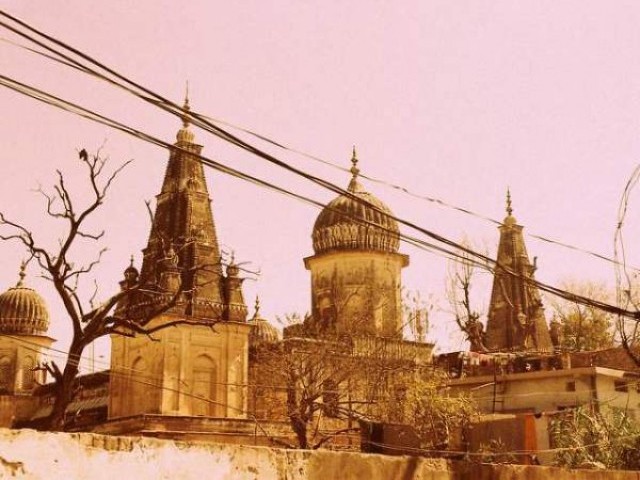
In Gurdwara Bagh Sardaraan. PHOTO: SHIRAZ HASSAN
The partition of India was based on the premise that a Bengali Muslim would be able to identify with the sorrows and issues of a Punjabi Muslim more than a Bengali Hindu.Of course, that was a vicious and diabolic notion because I believe that culture and heritage stand above religion.
I recently visited the dilapidated temples and gurdwaras of Rawalpindi and realised that the city still sings of her secular past.

The entrance to a temple in Gunjmandi. Photo: Shiraz Hassan
In the early 19th century, the British made Rawalpindi the central seat of military power as they aimed towards Afghanistan. This was in line with their strategic approach towards the Russian Empire in order to enjoy and retain complete control over central Asia.
Known as the Great Game, the conflict continues today in another form.

Details in a temple in Ganjmandi. Photo: Shiraz Hassan
After the partition in 1947, Rawalpindi continued to be the general headquarters of the army. But Pindi has a lot more to tell than just it’s military tales. The city is known for its heritage and culture. Its multi-religious character changed when almost all of its Hindu and Sikh inhabitants left for India. Sixty five years after partition, I went looking for their temples and Gurudwaras.

Ambardaran mandir, Bohar Bazaar. Photo: Shiraz Hassan
Walking around the old city, in areas like Krishanpura, Akaal Garh, Mohanpura, Amarpura, Kartarpura, Bagh Sardaraan, Angatpura, you can see Pindi’s heritage.
There are about ten dilapidated temples and Gurdwaras which are no longer functional. One temple located at Kohati Bazaar is in good condition. Its premises are used as a government school for disabled children.
Another beautiful Gurdwara known as Bagh Sardaraan is used by the Punjab Police as their main office.

A temple in Chungi. Photo: Shiraz Hassan
The temple located at Government Asghar Mall College is used as a scrap yard. A Shiva temple at Gunjmandi now houses storerooms or shops. There are a few more abandoned temples scattered around College Road, Bohar Bazaar, Purana Qilla, Bagh Sardaraan and then some on the outskirts of Rawalpindi which are about to collapse, or so it seems!

Takhpari mandir. Photo: Shiraz Hassan
In the old area of Lunda Bazaar, there used to be three temples, a Gurdwara, a Khalsa School and many Havelis belonging to the Hindus and Sikhs of the time. Of the three temples, two have survived. The third, of goddess Kali in the main bazaar, no longer exists. It has been converted into living quarters and extensions have been made, thus changing the original structure entirely.
In Lunda bazaar, there is a tall structure of a temple known as Mohan Mandir. This temple is believed to have been built by two Hindu Hakims in 1930, Hakim Asa Anand and Hakim Moti Ram.

Mohan mandir at Lunda Bazaar. Photo: Shiraz Hassan
It is sad that even though there are so many abandoned temples in Rawalpindi and Islamabad, there is not a single place for the Hindus living in the twin cities to celebrate their festivals like diwali, shivratri or holi.
There are more than 25,000 Hindus living in Rawalpindi and Islamabad. Some of them have migrated from other parts of Pakistan, mainly from Sindh.

A temple near Rawal dam in Islamabad. Photo: Shiraz Hassan

In Ganjmandi. Photo: Shiraz Hassan

In Ganjmandi. Photo: Shiraz Hassan
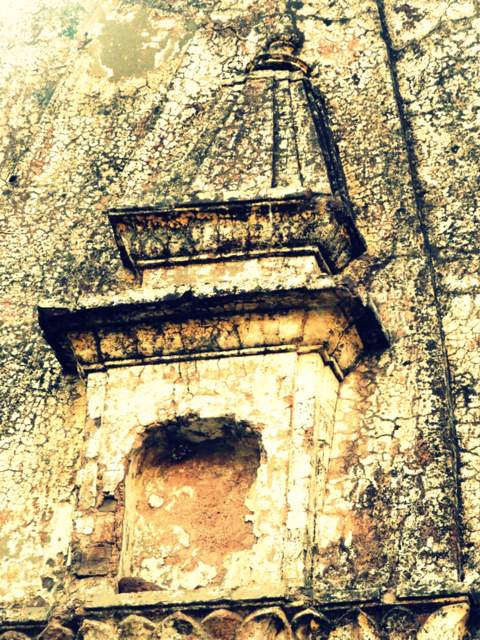
Details of a temple in Sagri village, Rawalpindi. Photo: Shiraz Hassan

In Purana Qilla, Rawalpindi. Photo: Shiraz Hassan
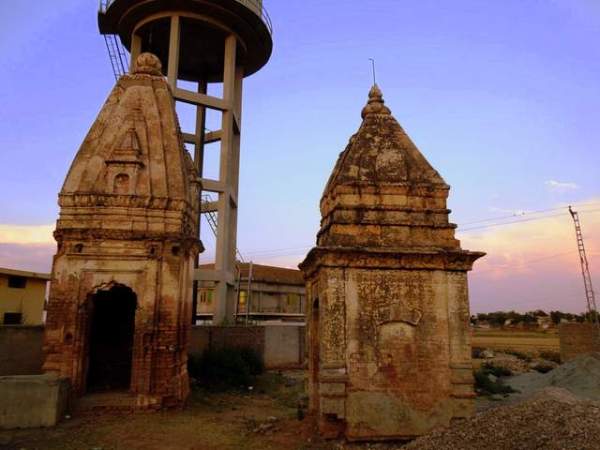
Twin temples in Sagri village, Rawalpindi. Photo: Shiraz Hassan

In Bagh Sardaraan. Photo: Shiraz Hassan

A detailed picture in Mohan mandir, Lunda Bazaar. Photo: Shiraz Hassan

In Ganjmandi. Photo: Shiraz Hassan

A temple near Rawal dam in Islamabad. Photo: Shiraz Hassan

In Sagri village, Rawalpindi. Photo: Shiraz Hassan

In Purana Qilla area. Photo: Shiraz Hassan

In Chungi. Photo: Shiraz Hassan
Recently, following a request from Ramesh Lal, a Hindu parliamentarian of the ruling Pakistan People’s Party, Prime Minister Raja Pervez issued a directive to the chairman of the Capital Development Authority to build a new temple for the Hindu community.
That is undoubtedly a good gesture, however, the government must also urgently restore and preserve the old heritage of the city- if not for the sake of the minorities still prevalent in our country then at least for the sake of history and heritage.
The Types of Wedding according to Hindu Shastra – Hindu Vivah
According to the ancient vedic culture there are mainly five legitimate types of wedding. Brahma, Daiva, Arsha, Pragaptya, & Gandharva. The rest forms of wedding that don't have recognization in the society are Asura, Rakshasa, & Paisaka. Gandharva vivah was recognized by the Kshatriyas and Vaishyas where as in a Brahmin Community it wasn't accepted.
Brahma vivah
A bride when married to a suitable Groom through a formally allied proposal is called as a "Brahma vivah".
In normal terms its referred to as "Arranged Marriage".
Daiva vivah
A bride when married to a Groom in return for a service or favour done by him regardless of the bride's consent, its termed as "Daiva vivah".
In ancient vedic period this kind of wedding was referred to an act where a maiden was offered to a Priest as a token of religious sacrifice.
Today such kinds of weddings are arranged under obligation of the Groom demanding the Maiden, in return for the help provided by him to her family without her consent. This can be even true for a Groom where he is forced to marry a maiden obliged by the favour done by the Bride's family towards his family.
Arsha vivah
The wedding where the maiden's guardian receives a gift in return for offering her as a bride to the groom is termed as "Arsha vivah".
Today such kinds of weddings are token of business alliances and deals in the business class families where individual consent from both Bride and Groom aren't considered. The Bride and Groom here are considered as the Social Gifts exchanged among the two families.
Pragaptya vivah
When a groom achieves a maiden as a bride on a demand put forth towards her family, without necessarily feeling a need to request for her consent, such a marriage is termed as "Pragaptya vivah".
Today such weddings are arranged on a proposal put forth by a highly regarded family towards the Maiden's family without necessarily considering her consent, but the social status of the family.
Gandharva vivah
When a Chap and a Maiden decide to unite in a sacred long term committed relationship, without the consent of Parents or Guardians, then such a wedding is called as "Gandharva vivah".
In general terms its referred to as "Love Marriage" which may or may not follow the Wedding Commandments.
Asura vivah
If a guardian sells a Maiden to a Groom then such a marriage is called "Asura vivah".
Today its not called as wedding, in fact the chap purchasing a maiden isn't necessarily a groom. This action is a darker side of the society that's ruining the social harmony, we pretend to stay away from such actions, but its the fact that just staying away won't be the solution.
Rakshasa vivah
If a Maiden is forcibly obtained under obsession for a marriage by a Chap then such a wedding is called as "Rakshasa vivah".
This action is widely attempted today which is an outcome of obsession. A Maiden is forced to marry a Chap under obligation or a threat put forth by him, just because he wants to possess her.
Paisaka vivah
If a Maiden is unconsciously embraced by a male in her sleep without her consent, then a relationship formed in such a manner is called "Paisaka vivah".
It's not considered as a wedding, neither the relationship is considered to be legitimate, but the fact still lies that the maiden who is victim is disregarded and abused by the society, and not the punk who has stole her virginity.
From the above the legitimate forms of weddings acceptable to the society are Brahma, Daiva, Arsha, Pragaptya, & Gandharva.
March 22, 2013

March 21, 2013
sunjay dutt

بھارت میں بالی وڈ کی فلمی صنعت کے معروف اداکارسنجے دت کو آج جمعرات کو نئی دہلی میں ملکی سپریم کورٹ کی طرف سے پانچ سال قید کی سزا سنا دی گئی۔
سنجے دت کو یہ سزا غیر قانونی طور پر ہتھیار اپنے پاس رکھنے کے جرم میں سنائی گئی ہے۔ غیر قانونی ہتھیاروں سے متعلق اس مقدمے کا تعلق 1993ء میں ممبئی میں ہونے والے ان بم حملوں سے تھا، جن میں257 افراد مارے گئے تھے۔
خبر ایجنسی ایسوسی ایٹڈ پریس کے مطابق نئی دہلی میں سپریم کورٹ نے اپنے فیصلے میں سنجے دت کو حکم دیا ہے کہ وہ آئندہ چار ہفتوں میں خود کو پولیس کے حوالے کر دیں۔ سنجے دت پر یہ الزام ثابت ہو گیا تھا کہ ان کے قبضے میں ایک ایسا پستول اور تین خودکار رائفلیں تھیں جو انہیں ایک ایسے شخص نے فراہم کی تھیں جس کو بعد ازاں ممبئی بم حملوں کے سلسلے میں سزا سنا دی گئی تھی۔
 سنجے دت کو سزا نئی دہلی میں ملکی سپریم کورٹ نے سنائی
بھارتی سپر سٹار سنجے دت کے خلاف یہ مقدمہ دو عشروں سے بھی زائد عرصہ پہلے ممبئی میں ہونے والے دھماکوں سے متعلق اُس طویل عدالتی کارروائی کا حصہ تھا جو اٹھارہ سال تک جاری رہی۔
سنجے دت کا کہنا ہے کہ انہیں ممبئی میں بم دھماکوں کے منصوبے کا کوئی علم نہیں تھا اور انہوں نے یہ ہتھیار اپنے اہل خانہ کی حفاظت کے لیے خریدے تھے۔ ان کے بقول انہوں نے یہ ہتھیار خریدنے کا فیصلہ اُن دھمکیوں کے بعد کیا تھا جو انہیں اور ان کے اہل خانہ کو ممبئی میں فرقہ ورانہ فسادات کے دوران ملی تھیں۔ سنجے دت پہلے ہی 18 مہینے جیل میں رہ چکے ہیں اور ان کی رہائی 2007ء میں عمل میں آئی تھی۔ انہوں نے جیل میں یہ وقت اپنے خلاف اس مقدمے کی سماعت کے دوران کاٹا تھا۔
سنجے دت کی عمر اس وقت 53سال ہے اور بھارتی سپریم کورٹ نے آج انہیں جو سزا سنائی ہے اس میں TADA کہلانے والے قوانین کے تحت قائم کردہ ایک عدالت کے سنجے دت کو سزا سنانے کے فیصلے کو بحال رکھا گیا ہے۔ خصوصی ٹاڈا عدالت نے ایک سو کے قریب افراد کو، جن میں سنجے دت بھی شامل تھے، 2006ء میں مختلف سزائیں سنائی تھیں۔
 مارچ 1993ء کے ممبئی دھماکوں میں 257 افراد ہلاک ہوئے تھے
نومبر2006ء میں سنجے دت کو TADA کی اب کالعدم ہو چکی انسداد دہشت گردی کی خصوصی عدالت نے غیر قانونی طور پر ہتھیار اپنے پاس رکھنے کے جرم میں چھ سال قید کی سزا سنائی تھی، جس کے بعد سپریم کورٹ کے فیصلے کی رو سے اب یہ بات تقریباﹰ یقینی ہو گئی ہے کہ سنجے دت کو اب قید کی باقی سزا بھی کا ٹنا ہو گی۔
12 مارچ 1993ء کے روز مغربی بھارت کے ساحلی شہر اور مالیاتی مرکز ممبئی میں ہونے والے کئی بم دھماکوں نے 257 افراد کی جان لے لی تھی اور سات سو سے زائد افراد زخمی ہوئے تھے۔ وسیع تر جانی اور مالی نقصان کا باعث بننے والے یہ دھماکے بنیاد پرست عناصر نے کرائے تھے۔
ان دھماکوں کے سلسلے میں کئی افراد کو سزائیں سنائی جا چکی ہیں۔ بھارتی حکام کے مطابق ان حملوں کی سازش مبینہ طور پر داؤد ابراہیم، ٹائیگر میمن اور اس کے بھائی ایوب میمن نامی مرکزی ملزمان نے تیار کی تھی جواب تک مفرور ہیں اور جنہیں بھارت میں اشتہاری مجرم قرار دیا جا چکا ہے۔


.jpg)


March 20, 2013
HISTORY OF HINGLAJ MATA PAKISTAN
Pakistan - Hinglaj Matagee Temple Balochistan
Hinglaj Matagee Temple Balochistan Pakistan
A trip to the Terath (Pilgramage) of past gods. This sacred place of pilgrimage for Hindus specially the devotees of Aadh Shakti Devi Maata is situated in the mountain cave "HINGLAJ" on the river bank of "HINGHOL" at the tail of Kheerthar mountains called Kanraj in tehsil Lyari of Balochistan province of Pakistan. It is considered one of the famous and largest TEERATHS Pilgramage of Subcontinent.
It is about 170 miles 250 KM from Karachi. One has to go by road on main Karachi-Quetta Highway (RCD) up to zero point for about 75 miles. Then by road towards west through Lyari town and then to Signal fauji camp stop,crosssing Aghore River. Then through Goongi River and last stop to "Asha Pura" sarai (INN). There are worship places of GANESH DEVA,MATA KALI,GURU GORAKH NATH DOONI,BRAHAM KUNDH,TIR KUNDH,MAHA KALI KUNDA,GURU NANAK KHARAO,RAM JAROKHA BETHAK,ANEEL KUNDH ON CHORASI MOUNTAIN and on the way CHANDRA GOOP , KHARI RIVER and AGHORI PUJA.
It is about 170 miles 250 KM from Karachi. One has to go by road on main Karachi-Quetta Highway (RCD) up to zero point for about 75 miles. Then by road towards west through Lyari town and then to Signal fauji camp stop,crosssing Aghore River. Then through Goongi River and last stop to "Asha Pura" sarai (INN). There are worship places of GANESH DEVA,MATA KALI,GURU GORAKH NATH DOONI,BRAHAM KUNDH,TIR KUNDH,MAHA KALI KUNDA,GURU NANAK KHARAO,RAM JAROKHA BETHAK,ANEEL KUNDH ON CHORASI MOUNTAIN and on the way CHANDRA GOOP , KHARI RIVER and AGHORI PUJA.
During the Treata Yuga, in the days of PERUSHURAM AVATAR , Rishi Dadechi narrated this story. In the TATARI MONGOL CLAN there lived a king named VICHATAR. He had two sons HINGOL and SUNDER. They belonged to Suria Dynasty of Kshtrya class.They were brave but cruel and lived luxurious lives. Their empire was adjacent to China. The people who lived in these countries belonged to Chandra Dynasty of Kshtrya Class and were followers of LORD SHIVA. Prince sunder attacked the neighbouring countries and killed thousands of people and looted gold ornaments and demanded royalties from them. The people then prayed to Lord SHIVA to save them from the cruel prince by fulfilling their prayers and request , Lord SHIVA granted a boon where GANESH DEVA killed the demon prince Sunder in three days. After the death of Prince Sunder , his brother Hingola became furious and swore to take avenge his brother's death. He underwent penance and by his austerity for years he received the boon that no living being in the three worlds could kill him with any sort of weapon and his death will only occur at a place where Sunlight does not penetrate. He thereafter defeated other kings, extended his reign with terror and cruelty. He referred to himself as HINGOl DEVA.People became very sick and tired in his reign and they performed great Yagna Hawan in their Devi Mata Temple in order to get rid of HIngol , the King. Devi Mata appeared and promised to kill Hingol.Hingol came in SATA DEEP, presently located in Balochistan and went inside a dark cave where Devi Mata with her wooden weapon TRISHUL killed him. In his last moments of life hingol prayed to Devi Mata that in future this place may be called after his name as HINGAL TEERATH and so the place came to be known.
According to another story in the PURAN , once SATI the consort of LORD SHIVA and the daughter of King Daksha was annoyed with her father for not inviting LORD SHIVA in the ceremony of Yagna. She jumped to in Agni Havan Kunda and burnt herself. LORD SHIVA then became furious and came and took the dead body of SATI and started roaming in all the dishas and there was danger created all over the world. Hence LORD VISHNU cut the body of SATI in pieces with his Sudarshan Chakra in order to cool down LORD SHIVA's anger. The pieces of SATI'S body fell at differant places; the head fell at KUNRAJ mountain and was so called as HINGLAJ TEERATH of SHAKT DEVI MATA. 50 pieces at different places and were known as DEVI TEERATH ASTHANS also by differant names. There is no doubt that HINGLAJ TEERATH is very old and remained famous even during Mahabharat period when King Jaidrath of Sindh constructed Devi temples. When King Sikander of Yoonan, Europe when invaded India, he fought with King Balram at Bali Kot Fort and stayed at Hingol River. At that time, yatri devotees were performing HInglaj Yatr and they were safe. Samrat Vikramjeet, the king of India also visited Hinglaj as yatr after conquering all of India. Raja Todarmal of Mughal regime also visited this teerath. Other Rajput rajas like Bihari Mal, Raja Bhij Singh, Raja Madhoo Singh, Raja Jagat Singh of Jaipur, Ram Devji Pir of Rajasthan with his Army chief Agva Laloo Jakhraj also came to Hinglaj for yatra, Dada Mekhan the great saint of Gujarat also came to Hinglaj Teerath and he was called first KAPRI of Mata and after this all the Yatris are called KAPRIS. Kapris wear mala of Thumra in their neck
According to another story in the PURAN , once SATI the consort of LORD SHIVA and the daughter of King Daksha was annoyed with her father for not inviting LORD SHIVA in the ceremony of Yagna. She jumped to in Agni Havan Kunda and burnt herself. LORD SHIVA then became furious and came and took the dead body of SATI and started roaming in all the dishas and there was danger created all over the world. Hence LORD VISHNU cut the body of SATI in pieces with his Sudarshan Chakra in order to cool down LORD SHIVA's anger. The pieces of SATI'S body fell at differant places; the head fell at KUNRAJ mountain and was so called as HINGLAJ TEERATH of SHAKT DEVI MATA. 50 pieces at different places and were known as DEVI TEERATH ASTHANS also by differant names. There is no doubt that HINGLAJ TEERATH is very old and remained famous even during Mahabharat period when King Jaidrath of Sindh constructed Devi temples. When King Sikander of Yoonan, Europe when invaded India, he fought with King Balram at Bali Kot Fort and stayed at Hingol River. At that time, yatri devotees were performing HInglaj Yatr and they were safe. Samrat Vikramjeet, the king of India also visited Hinglaj as yatr after conquering all of India. Raja Todarmal of Mughal regime also visited this teerath. Other Rajput rajas like Bihari Mal, Raja Bhij Singh, Raja Madhoo Singh, Raja Jagat Singh of Jaipur, Ram Devji Pir of Rajasthan with his Army chief Agva Laloo Jakhraj also came to Hinglaj for yatra, Dada Mekhan the great saint of Gujarat also came to Hinglaj Teerath and he was called first KAPRI of Mata and after this all the Yatris are called KAPRIS. Kapris wear mala of Thumra in their neck


.jpg)


.jpg)
.jpg)
.jpg)


March 19, 2013

March 16, 2013
IT HAPPENS ONLY IN INDIA
- Associated Press - A Swiss woman, center, who, according to police, was gang-raped by a group of eight men while touring by bicycle with her husband, is escorted by policewomen for a medical examination at
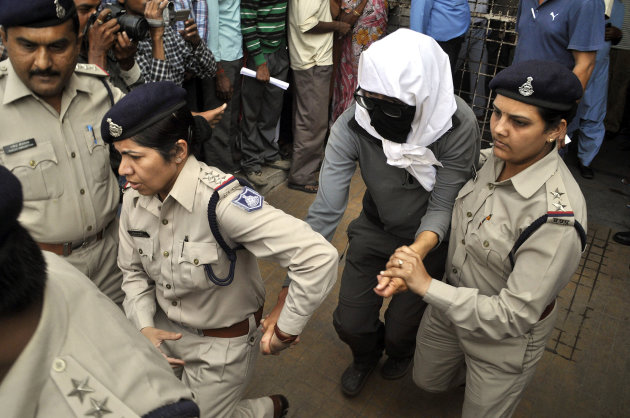
NEW DELHI (AP) — A Swiss woman who was on a cycling trip in central India with her husband has been gang-raped by eight men, police said Saturday. The attack comes three months after the fatalgang-rape of a woman aboard a New Delhi bus outraged Indians.
Authorities detained and questioned 13 men in connection with the latest attack, which occurred Friday night as the couple camped out in a forest in Madhya Pradesh state after bicycling from the temple town of Orchha, local police officer R.K. Gurjar said.
The men beat the couple and gang-raped the woman, he said. They also stole the couple's mobile phone, a laptop computer and 10,000 rupees ($185).
The woman, 39, was treated at a hospital in the nearby city of Gwalior, Gurjar said.
A photo showed the woman walking while being escorted by police to the hospital. Her face was concealed with a hood, a common practice in India, where law does not allow rape victims to be identified publicly to protect them from the stigma attached to rape in the conservative country.
Police detained 13 men and questioned them, Gurjar said. Six of the men were released after questioning. No other details were immediately available.
Indian television stations showed scores of police searching the forest where the attack occurred.
Swiss Foreign Ministry spokesman Tilman Renz described the case as "deeply disturbing" and said Swiss diplomats were assisting the couple.
The diplomats called on Indian authorities "to do everything to quickly find the perpetrators so that they can be held accountable," Renz said in a statement.
Last month, the Swiss government issued a travel notice for India that included a warning about "increasing numbers of rapes and other sexual offenses" in the South Asian nation.
India has seen outrage and widespread protests against attacks on women since December's fatal gang-rape of a young woman on a moving bus in New Delhi, the capital. The crime horrified Indians and set off nationwide protests about India's treatment of women and spurred the government to hurry through a new package of laws to protect them.
One of six suspects in the December attack was found dead in a New Delhi jail this past week. Authorities said he hanged himself, but his family and lawyer insisted foul play was involved. A magistrate is investigating. Four other men and a juvenile remain on trial for the attack.

March 11, 2013
.jpg)


.jpg)
.jpg)


Subscribe to:
Posts (Atom)